Teaching experience in the academic job market
“Evidence of teaching effectiveness” adds to the ever-growing demands on graduate students.


What constitutes “evidence of teaching effectiveness” and do graduate students need such evidence to enter the competitive academic job market? To answer this question, we must look at what kinds of positions are available to recent graduates and what materials are required of applicants in the first stage of the hiring process.
The Academic Job Market by the Numbers
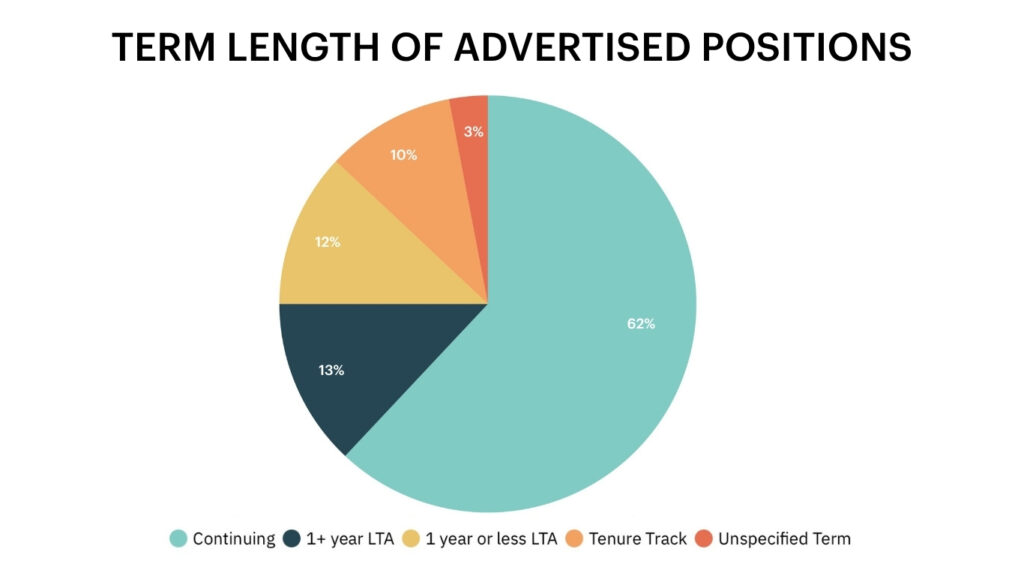
We catalogued 2022 job postings on University Affairs that were open to recent graduates with terminal degrees (i.e., the highest attainable degree in a given field, often a PhD but sometimes an MFA or other masters level degree), creating a data set of 2104 job ads. After removing ads that did not specify what materials were needed to apply, we were left with a final catalogue of 2015 job ads, reflecting 370 jobs in humanities departments, 766 in social sciences departments, and 879 in STEM departments. Of note is the number of limited-term appointments (LTAs) reflected in this catalogue. The chart below illustrates the term-length of the positions advertised, with limited-term appointments accounting for 25 per cent, tenure-track and continuing for 65 per cent, and positions with unspecified term length accounting for the remaining 10 per cent.
What role does teaching experience play in first-round applications?
These ads revealed several possibilities of what might be considered evidence of effective teaching by higher education employers, including:
- Statement of teaching philosophy or experience
- Teaching dossier
- Student evaluations
- Previous course outlines
- Peer evaluations of teaching or peer references related to teaching
- A record of pedagogical presentations
- Newly created course outlines tailored to the needs of the department advertising the position
- Videos of teaching
- Student work
Among these forms of evidence, the most often requested were teaching statements, teaching dossiers, and student evaluations. There was significant variation in what institutions and departments considered a “teaching dossier,” with some ads imposing a two-page limit, others asking that dossiers include sample course outlines and student evaluations, and the majority never defining what the dossier should include. To account for this variety, all ads that required a teaching dossier werecoded as requiring a dossier and, when further detail as to what the dossier needed to include were provided, those elements were coded as separate requirements (i.e., an ad requesting applicants to submit a teaching dossier that includes a teaching statement and student evaluations was coded as requiring a teaching dossier, a teaching statement and student evaluations, while an ad requiring a teaching dossier with no further clarification was coded as requiring only a teaching dossier).
The heat map below shows the frequency with which various documents were requested of first round applicants, depending on the term length (e.g., limited term appointment or continuing). Elements related to teaching effectiveness are bolded. Note that this table is not an exhaustive catalogue of all application requirements, as the focus of this inquiry was painting a broad picture of the application process, with an additional zoom-in on evidence of teaching effectiveness to demonstrate what, if any, teaching experience institutions expect of their applicants.
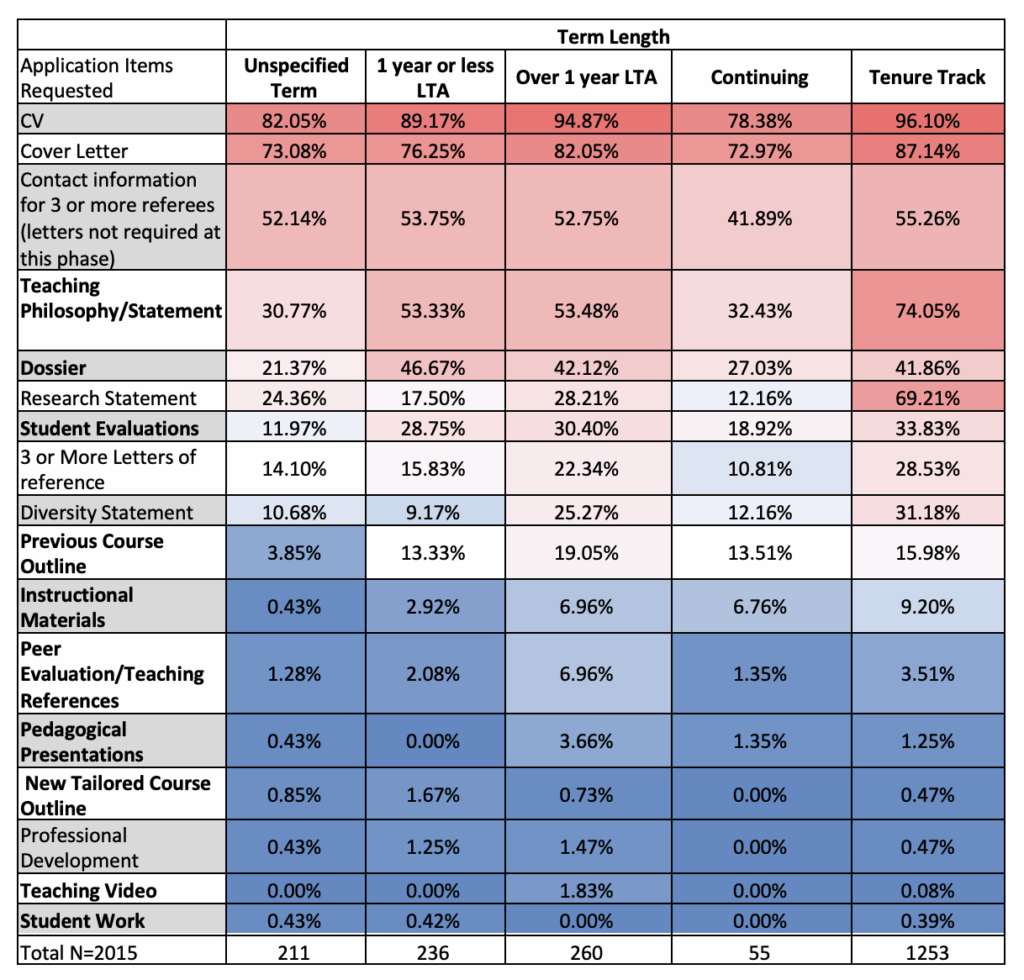
In the above summary, “teaching statement” refers to both statements of teaching philosophy and statements of teaching experience and interest. We combined these entries in part to account for the varied ways in which institutions ask candidates to reflect on their teaching experience, interests and approaches. When “evidence of effective teaching” or similar wording occurred in a job ad we recorded what, if any, parameters the ad stated around what might constitute such evidence.
These postings show us that teaching materials are being requested earlier in the hiring process, as compared to earlier studies (Meizlish & Kaplan 2008, Sheffield 2013) that noted the increasing value of teaching experience in academic hiring but found that teaching efficacy was more often evaluated at the interview or campus visit stage than it was in the initial application. It is common practice to advise graduate students to tailor application materials, such as cover letters, to the institution.Requiring teaching materials early in the hiring process means applicants are at best tailoring more materials and at worst creating brand new materials that are idiosyncratic to a single application to get past the first round.
What does this mean for graduate students?
It is common practice to advise graduate students to tailor their application materials to the position to which they are applying. Universities asking for evidence of teaching excellence earlier in the process, means prospective candidates are called to produce robust materials, customized to the teaching responsibilities of each position, before they are short-listed. If we take these job requirements as an indication of the experiences graduate students need for professionalization, then our responsibility as higher education professionals is to consider potential gaps between what can reasonably be acquired during graduate studies and what we are asking of job candidates. Depending on your sphere of influence, that might mean promoting opportunities for graduate students to reflect on teaching practices and craft teaching philosophies informed by their time as students and as TAs, advocating for course evaluations for TA work, or, as Columbia University professor Julie Stone Peters argues for in a 2025 Chronicle of Higher Education opinion piece, advocating for radically simplifying what is asked for in first round applications.
This data set demonstrates that teaching development cannot be postponed until after graduation as even precarious or short-term roles require documented teaching practice. It further confirms what many of us already know — that the process of applying for academic jobs is getting more onerous and we are asking a lot of our emerging academics.



Featured Jobs
- Finance - Faculty PositionUniversity of Alberta
- Medicine - Associate or Full Professor Professor (Kidney Health)Université de Montréal
- Architecture - Assistant Professor (environmental humanities and design)McGill University
- Sociology - Tenure-Track Position (Crime and Community)Brandon University
- Engineering - Assistant or Associate Professor (Robotics & AI)University of Alberta
More from Teaching
-

Reflection on five years of The Skills Agenda
Faculty innovation is key to advancing student career preparation in the years ahead.
-

Teaching physicians, med students battle Quebec’s Bill 2 with strikes and lawsuits
Students strive to make up for lost time after fall labour disruptions.
-
The Slow Professor ages well
The recently published 10th anniversary edition adds new material to this classic text.
-

Clinical teaching stoppage delays Quebec med students’ graduation
Legault government passes special legislation changing doctors’ pay structure and ordering clinical educators back to work.
More from Responsibilities May Include
-

Working with students
Creating a thriving on-campus work experience.
-

From Postdoc to Research Faculty crash course
A collaborative approach to supporting Toronto postdocs with academic job searches.
-

Addressing the gap in academic professionalization for graduate students
Academic support units have an important role to play in the professionalization of graduate students.
-

Learning-centric programming: strategies to support meaningful engagement
Some practical strategies to design an experience with a clear purpose woven with meaningful engagement.

Post a comment
University Affairs moderates all comments according to the following guidelines. If approved, comments generally appear within one business day. We may republish particularly insightful remarks in our print edition or elsewhere.