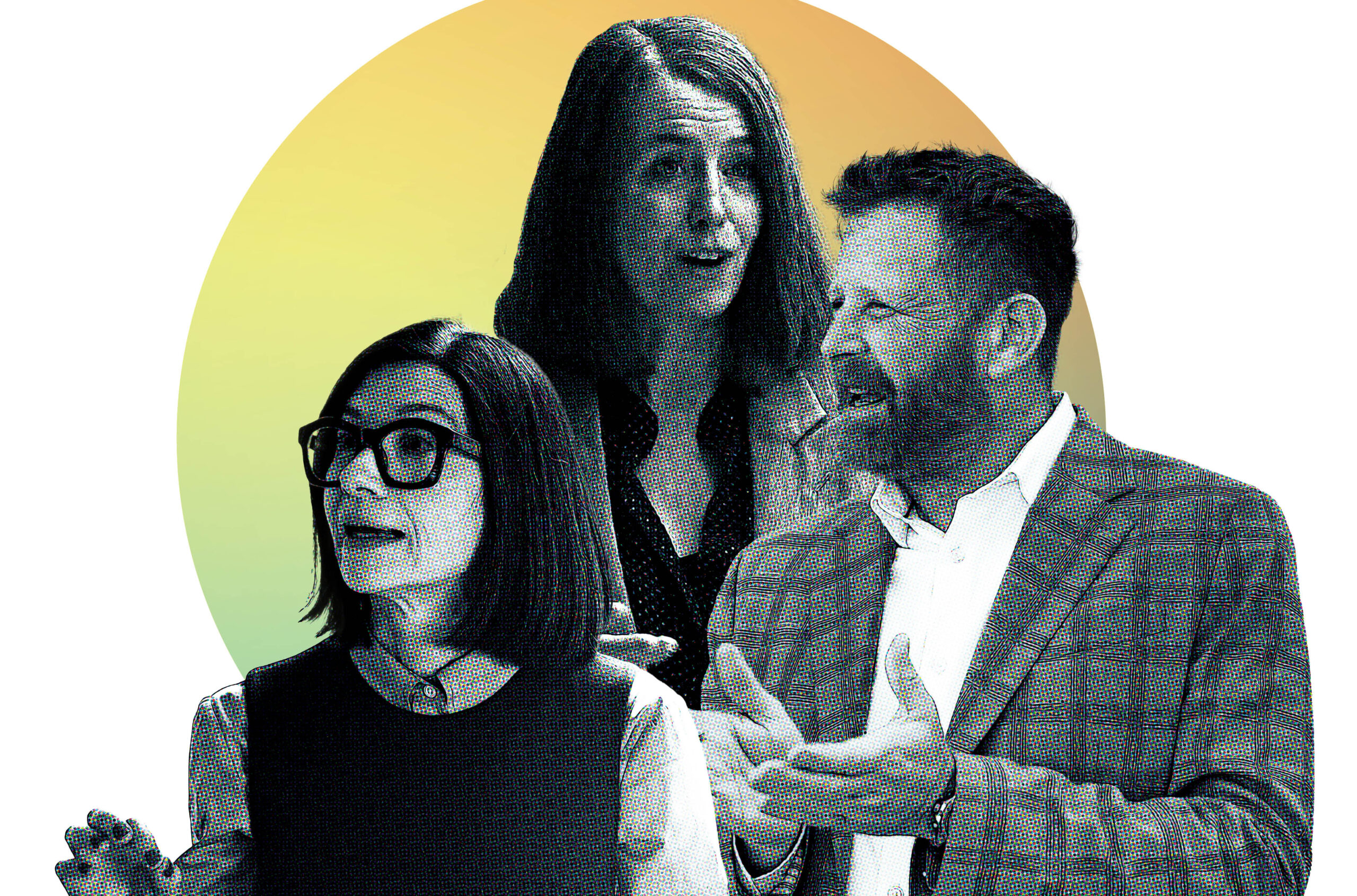
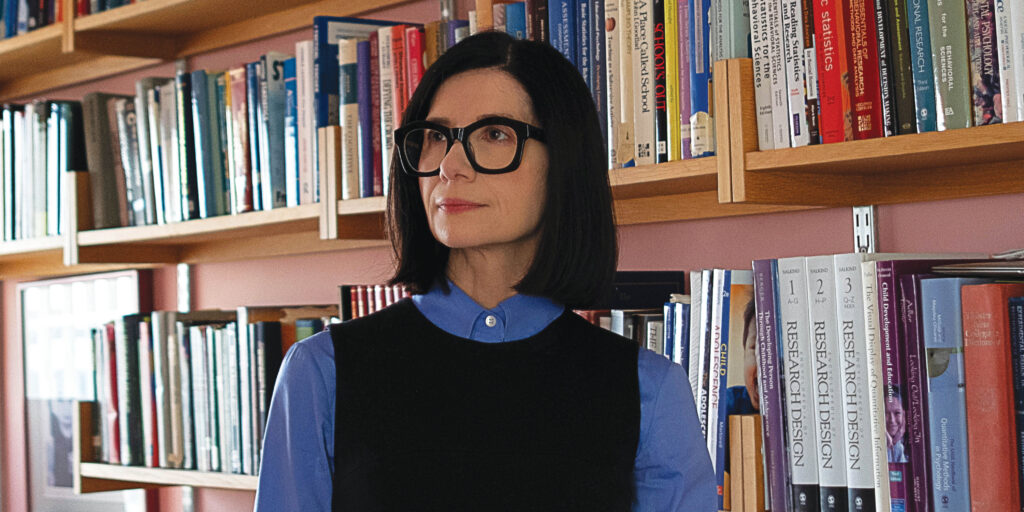
Before she begins each course, Jacqueline Leighton speaks to her students about freedom of expression. Growing up in Chile as a young girl, she witnessed the 1973 coup d’état that brought dictator Augusto Pinochet to power. The far-right regime quashed civil society by banning public assembly, censoring media and purging universities of leftist sympathizers. Pinochet’s military junta employed torture, imprisonment, disappearances and murder to establish its 17-year-long authoritarian rule, causing thousands to flee the country — including Dr. Leighton’s family, who immigrated to Brazil before arriving in Calgary in 1978.
“People went missing for the things that they said against the government,” she says. “That instilled in me such an important and passionate endorsement of being allowed to speak and fighting for other’s right to speak — including students.”
Since then, the educational psychologist has spent three decades in the university community, completing her PhD from the University of Alberta (U of A) and a postdoctoral fellowship at Yale, before returning to her alma mater as an instructor.
That freedom of expression might be under threat wouldn’t have crossed her mind 25 years ago, says Dr. Leighton; even 10 years ago, she wasn’t concerned. Today she is. “I’m concerned for the student experience but also for what the university is becoming if we’re not able to explicitly promote a real diverse set of ideas and debate. Debate can be respectful,” she says. “I don’t know when the university became uncomfortable with difficult conversations. I mean, it’s what we do.”
Although U of A has a policy protecting freedom of expression, Dr. Leighton says that beginning in 2017, she observed, anecdotally, a reluctance from students to engage in classroom discussions. In 2019, students approached her confidentially to say they felt uncomfortable contributing. “They found that in other courses they were taking, unless they prescribed or endorsed a professor’s political orientation in their arguments, they felt they would be deducted marks.”
Dr. Leighton says she is not political. However, the rise of a left-leaning monoculture, as she describes it, is one of the reasons that, in 2022, she joined an organization of academics called the Heterodox Academy.
“One of the reasons I love the university is that they’ve been these institutions that embrace liberal values – I love that,” she says. “But if you have a strict ideology, you don’t actually embrace liberal values. You’re in the business of narrowing values and narrowing speech.”
She asks: “When did the very tool that social justice warriors have to be able to communicate, freedom of expression, freedom of ideas and debate, become associated with the right?
In the three years since Dr. Leighton joined the Heterodox Academy, the ideological left has lost much of its political power and seen its cultural influence wane. Particularly in the United States, ascendent right-wing politicians are using the left’s erstwhile cancel culture as a weapon against it, shutting down left-wing critiques of conservative views.
The Heterodox Academy is attempting to occupy the middle ground: hoping to reform the higher education landscape from the inside, to show that difficult conversations across differences are possible, both among faculty and in the classroom.
“We need to remain civil toward each other,” Dr. Leighton says, “because we do not know when the course of history might change the tables on us.”

The Heterodox Academy formed as a reaction to what it describes as “the rise of close-minded orthodoxies within scholarly communities that stifle rigorous, truth-seeking investigation of complex questions and issues.” Since its 2015 founding by American academics Chris Martin, Nicholas Rosenkranz and Jonathan Haidt, the organization has grown to approximately 7,400 members. There are currently nine formal chapters, called “campus communities” of the Heterodox Academy in Canada, and more than 500 members. The first two, the University of Toronto and McGill University, joined in 2023. The University of Waterloo joined this fall, only days before the American right-wing activist Charlie Kirk was assassinated on a university campus in Utah.
These faculty find intellectual refuge in rallying behind three core “heterodox” values: viewpoint diversity, constructive disagreement and open inquiry. To what extent these values are under threat in Canada’s academic system is subject to debate, but all members interviewed by University Affairs believe that they need promoting.
Geoff Horsman, an associate professor of biochemistry, co-leads the Heterodox Academy chapter at Wilfrid Laurier University. The umbrella organization, which he terms “the mothership,” provides leaders of campus chapters financial and other resources — like mentorship and toolkits that it touts for “reclaiming the culture of higher education”— to host events and advocate for policies and practices that support heterodox values. The advice he was given, when first founding a chapter at Laurier, was to go slow and build community.
About 12 faculty attended the first meeting, which he organized at a campus pub in the fall of 2023. “You could see people getting there and being able to put sail — they were speaking openly. It was kind of cathartic, almost like a therapy session, because this was a place that valued the free exchange of ideas and debate.”
The following spring, Dr. Horsman organized the first WLU Heterodox Community event by inviting lawyer Lisa Bildy to present on the topic of regulation of speech by professional bodies. Ms. Bildy had defended a Vancouver-based nurse, Amy Hamm, who was investigated by the B.C. College of Nurses and Midwives after expressing disbelief in the concept of gender identity and opining that certain sex-segregated spaces, such as washrooms and prisons, should be reserved for biological women. A protest against Ms. Bildy was organized by student groups and the chapter of the Public Service Alliance of Canada that represents teaching assistants at Laurier.
My view is that it’s a university — we need to talk, to debate, and to figure things out.
The presentation went on, and a number of protesters sat through the presentation; some even asked questions. “I thought that was a success, that we engaged them. That there’s nothing to be frightened about,” says Dr. Horsman. But attendees who had at first expressed interest in joining the Heterodox Academy bowed out. “Some said to us that they felt scared — there were all these activists there, administration was involved, and they felt, ‘I can’t risk this.’”
While Ms. Bildy’s lecture was allowed to continue, there have been several incidents of deplatforming, censorship and in one case, violence, on ideological grounds against Canadian lecturers or invited guests to campuses. Scholars at Risk’s Academic Freedom Monitoring Project includes two examples in Canada, both in 2023, that the not-for-profit group cite as undermining academic freedom and democratic society generally.
The first is the cancellation of a lecture at McGill University by gay-rights lawyer Robert Wintemute, a King’s College London law professor, after around 100 transgender rights activists disrupted the event by throwing flour and cutting power to the projector. Protesters accused Mr. Wintemute and the LGB Alliance, with which he is affiliated, of being anti-trans, a charge he disputes.
Then, on June 28, a former student walked into the class of Kate Fulfer at the University of Waterloo and demanded to know what she was teaching. Upon her reply, gender studies, the assailant pulled out a knife, stabbing Dr. Fulfer and two students. The attack, though not fatal, is a tragic and dark reminder that Canada isn’t immune to ideological violence on campus.

The Heterodox Academy is a non-partisan organization; its Canadian members vary widely across the political spectrum and with their active involvement in the group. Anoush Terjanian, a fellow at the Human Rights Research and Education Centre at the University of Ottawa, describes herself as a “participant observer.”
Before returning to Canada in 2018, Dr. Terjanian became the founding director of the US Social Science Research Council’s Anxieties of Democracy program, where she led a team of 75 researchers to better understand the dilemmas of established democracies. She joined the Heterodox Academy in 2022. “I understood that in Canada, we are not immune to many of the polarizations that I had witnessed in my career in the United States, and the Heterodox Academy offered an interesting opportunity for me to learn as what I would call a participant observer of a disposition I found important for the sake of our higher education and tertiary education community, for the sake of the research community, and for the sake of our democracy.”
That disposition is what the Heterodox Academy calls “The HxA Way,” a set of five norms that members are encouraged to embody professionally to foster constructive engagement across lines of difference. They are: to make your case with evidence, to be intellectually charitable, to be intellectually humble, to be constructive, and to be yourself.
“I am interested in building a world where we can have reasonable debate, and all of those features of the Heterodox Way — curiosity, charitability, evidence, intellectual humility, constructive disagreement — are why I joined,” says Dr. Terjanian. “I would add that on balance I have not observed a great diversity of viewpoints [in the Heterodox Academy].”
Many members of the academy interviewed say that these norms can fall by the wayside — in the classroom, but also among faculty. Martin Drapeau, co-chair of McGill’s chapter, had taken to posting the list on his door — only to see it be torn down several times over the last two years. It isn’t surprising to him.
Dr. Drapeau still feels like a persona non grata in his department following a controversy among faculty in 2020. A clinical psychologist, Dr. Drapeau was sitting on the admissions committee for the highly competitive undergraduate psychology program, which awarded points to students for academic performance, volunteer work and prior clinical experience. After ranking students on “hard criteria,” the committee would consider factors like representation.
However, that year, he said, the program planned to introduce a new scoring category, to be used in interviews with prospective students, that would award points for membership in historically underrepresented groups which generally included race, sex, religion, gender identity and sexual orientation. “I and other colleagues were extremely appalled by this, because it meant that in interviews, we would have to ask students, basically, who do you sleep with?” he says.
Dr. Drapeau says that when he raised his concerns with colleagues about the new scoring system, the environment was so polarized that it quickly devolved into name-calling. “It turned into that anyone who was opposed was basically transphobic — whoa, where does that come from? And misogynistic. And I was called a Trump supporter. It was absolutely insane.”
In December 2020, Dr. Drapeau authored an op-ed in the French-language newspaper Le Devoir outlining his opposition to the policy, writing:
“Ironically, if the exercise were truly about diversity, we would need to admit more men into our programs, since in a typical cohort of 20 or 25 students, there are usually only one or two. We would also need to admit more francophones […] and we would need to admit more Quebecers of all backgrounds, regardless of origin.”
Practically overnight, Dr. Drapeau was cancelled. Faculty members insulted him and his clinic, telling students not to work with him, he says. Students wrote letters to the dean, asking that he be suspended. And in the case of three colleagues, he filed complaints for harassment with the Quebec labour board CNESST (Commission des normes, de l’équité, de la santé et de la sécurité du travail), which he says is now taking action against McGill. (The labour board refused to confirm or deny whether it was acting on those complaints due to confidentiality.)
Dr. Drapeau, who describes himself as left-leaning, says he supports equity, diversity and inclusion (EDI) in principle, but that debates surrounding the implementation of EDI policies have been suppressed. “People are demonizing each other, straw-manning each other, careers are broken. As a society, we seem to tolerate cancel culture and public denunciations,” he says.
“My view is that it’s a university — we need to talk, to debate, and to figure things out,” he says. “What is the university for? What’s the mission of the university? Is it to give good training, good access to jobs? Is it to promote research, therefore truth and science?”
Debates over a university’s mission are perennial. But the Heterodox Academy emerged at a moment when equity has increasingly been seen as a core value of higher education. Decades of national and provincial legislation and advocacy work have sought to correct historical injustices and access to higher education for groups such as women, Indigenous peoples, persons with disabilities and visible minorities. The last decade especially has been marked with successful equity-related efforts in Canada’s university and research system. EDI practices, rooted in multiple theoretical frameworks, human rights principles and workplace legislation, have proliferated across Canada’s universities and research ecosystem since 2017.
That year, in response to a human rights complaint made several years earlier by a group of women professors against an overwhelming lack of diversity in the Canada Research Chairs Program, the program began requiring institutions with five or more chair allocations to develop EDI action plans and publicly report on progress towards targets.
By 2019, 77 per cent of Canadian universities explicitly referenced EDI in their strategic plans. In 2020, in the wake of George Floyd’s murder in Minneapolis, and with the ongoing response to the Truth and Reconciliation Commission’s 2015 final report, universities began inclusive excellence programs to hire Black and Indigenous scholars and began anti-Black racism initiatives. In the two years that followed, there was a massive proliferation of senior EDI roles at Canadian universities, and in 2022, 89 per cent referred to EDI within their strategic plans, according to a Universities Canada survey. Today, EDI in academia is facing a backlash, driven by the perception that its principles are at odds with the university’s commitments to open inquiry, academic freedom and civil discourse. At the federal government level, the House of Commons Standing Committee on Science and Research is studying whether EDI should remain a key component in allocating research grants, with a report expected this fall. Academics testified to the committee on both sides of the issue.
Heterodox Academy does not support the attacks on the universities by the Trump administration.
It is within this context that debates over freedom of expression are playing out, often between two opposite sides of the ideological spectrum: those on the far left who seek to silence individuals considered enemies of equity; and far right advocates, some of whom, in the name of freedom of speech, oppose all constraints on expression, while others seek to quash the expression of left-wing values.
The majority of Heterodox Academy members interviewed say that EDI initiatives have benefitted the university system. Members like Neil McLaughlin, a professor of sociology and co-chair of the McMaster University chapter, express trepidation at the thought of the Heterodox Academy being associated with a movement against equity, and especially with the crackdown on universities in the U.S. “Heterodox Academy does not support the attacks on the universities by the Trump administration,” he says.
Other academy members, however, oppose EDI, and argue that their opposition should not harm their research funding prospects or academic careers.

Dr. Horsman, who testified to the standing committee, has become a vocal critic of EDI in the federal research system. He believes that EDI statements — a section of the research application where applicants must demonstrate their commitment to equity, diversity and inclusion — amount to compelled speech. The EDI section for a recent renewal of his Discovery Grant, administered by the National Science and Engineering Research Council, was mandatory, and, if the reviewers judged it insufficient, it would automatically result in a failed grant application. Dr. Horsman says that colleagues, including a senior administrator, advised him to “play the game”; essentially to make it up in order to receive funding. “Some articulated to me that we all know this is nonsense, so you just write it — you’re not lying to anyone important, you’re lying to the politburo. Well, I’m not going to lie.”
In his statement, Dr. Horsman argued against the EDI procedure itself. “I think EDI itself as a practice requires racial discrimination, it requires compelled statements for grants. There’s censorship involved, biased and anonymous reporting, systems that really suppress speech.”
He didn’t get the grant. Now, Dr. Horsman is likely unable to hire any graduate students for his lab, but he says the principle is more important — if the policy remains, and his lab closes, so be it. “I want to make sure that people who are opposed to these things are included as well.”
In November 2024, the Heterodox Academy employed a Campus Expression Survey, adapted for Canadian use, to understand whether students were afraid to broach controversial topics and share honest ideas, opinions and questions in class. It was administered to 1,584 postsecondary students across Canada.
Students who identified as “very left” or “very right” on the political spectrum felt most comfortable discussing controversial issues, the survey found, with Israel-Palestine, transgender identity and politics being the issues that students are most reluctant to speak about. The survey also found that nearly 40 per cent of respondents had experienced negative consequences after sharing their thoughts, such as university faculty or staff reprimanding them, others filing formal complaints against them, or faculty or other students denouncing them on social media. The majority of students — 63 per cent — feared at least one formal consequence and were more concerned about retributions from professors than peers.
However, the survey also revealed fairly high support for some restrictions on freedom of speech and expression in the classroom. Fifty per cent of those surveyed agreed to the statement “getting rid of inequality is more important than protecting the so-called ‘right’ to free speech” and the majority of “very left” students (53 per cent) and “very right” students (62 per cent) at least somewhat agreed that “classroom discussions should be safe places that protect students from disturbing ideas.”
Student safety, as an argument — or to skeptics, a pretext — for censorship is an issue addressed by Dr. Haidt, the Heterodox Academy board chair, in his bestselling 2018 book The Coddling of the American Mind: How Good Intentions and Bad Ideas Are Setting up a Generation for Failure, co-authored with lawyer Greg Lukianoff. The book is based on an observation by Mr. Lukianoff that students, who historically have been opposed to calls for campus censorship, had become the ones to demand it. Speaking in a PBS interview, Dr. Haidt said students arriving to college campuses around 2015 brought “new ideas” about “fragility” that the authors didn’t fully understand, including “this idea that speech is violence — that words are dangerous.”
To defend everyone’s right to freedom of speech regardless of their views or their social identity is a profoundly radical position.
The authors argue that the concept of speech as violence arose in part due to two interconnected phenomena. The first was a fundamental shift in social media between 2009 and 2012, driven by the introduction of Facebook’s “Like” button and the launch of Twitter, which allowed people to communicate to millions of strangers. Algorithms for both platforms were optimized to reward engagement rather than chronology, virally spreading the posts that triggering the strongest emotional reactions. Essentially social media created an outrage machine.
The second phenomenon is the rise of “safetyism,” meaning the cultural or institutional tendency to prioritize emotional or physical safety above all other values, even at the expense of freedom, personal development, or open debate. As rates of depression, anxiety, self-harm and suicide rose among youth, who were the first generation to grow up from their earliest childhood online, institutions responded with practices that “overreach in their goals of protecting students from harm” and “undermine our ability to solve important social problems,” the authors argued. One of those practices is protecting students from ideas that may be deemed harmful to them.
Among those influenced by Haidt’s writing is McMaster’s Dr. McLaughlin, who joined the Heterodox Academy in 2017. Dr. McLaughlin describes himself as a “real leftie” — a political radical even. Still, he believes that speakers should be allowed on campus regardless of their political opinions. “Fifteen years ago, the Palestinian students on campus wanted to have Israeli Apartheid week, and I was involved in mobilizing to allow students to have their say,” he says. Then, in 2017, controversial speaker Jordan Peterson was shut down by protesters who drowned out his talk with shouting and noisemakers. “Cancelling Jordan Peterson was a big mistake because it made the university seem authoritarian,” he says. “He should have the right to speak, even though I don’t agree with him politically.”
Dr. McLaughlin, who studies the rise of public intellectuals and higher education, believes it is dangerous to claim hurt or harm when all one is confronting is an idea; opposing actual hate speech, with its advocacy for violence, is one thing (and Canada has laws that restrict this type of speech). But claiming that unpopular ideas promote hatred is yet another.
“To defend everyone’s right to freedom of speech regardless of their views or their social identity is a profoundly radical position, far more radical than those who claim harm when all they are confronting is an idea,” wrote Dr. McLaughlin for Human Rights Quarterly in 2022 with co-author Rhoda E. Howard-Hassmann. In what could be considered a moment of prescience by the authors, they continued: “At the time of writing this article, both its authors were worried about the emergence of authoritarian governance in the United States. There is a real danger that the political right will actively censor speech by the left — indeed even by moderate liberals — as the forces of right-wing populism and authoritarian governments grow. In its attempts to do so, the right will be aided by those on the academic left who reject the principles of freedom of speech and who advocate censorship instead.”
Three years on, the world is watching as such scenarios play out, with the second administration of Donald Trump cracking down on freedom of speech and university autonomy. At the time of writing, the White House has sent letters to nine of the nation’s top universities, urging administrators to support the Trump agenda. Among the dictates: to subscribe to strict definitions of gender and to prohibit anything that would “punish, belittle and even spark violence against conservative ideas.”
Canada is not the U.S. But neither is it immune to the forces that promote polarization across political and ideological lines. Supporting freedom of expression for all people — regardless of their views — is now more important than ever, says Dr. Leighton.
“Words are not the same as physical violence,” she says. “And it’s important for us to draw that distinction — because what I am afraid of is that if words are violence, then violence may be used in response to words.”
More from Features
-

The Nuisance Variable
Two-thirds of Alzheimer’s patients in Canada are women. Why does research still treat them as an afterthought?
-
Quebec universities: 60 years of change
From the Quiet Revolution to the present day, universities have profoundly transformed Quebec society. As a provincial election rapidly approaches, we reflect on their changing mission over six decades of often tense history.
-

A bridge to human rights
IDRA scholarship winner Karen Spring studies Central American communities seeking redress for harms caused by major development projects.
-
Heat waves and brain waves
IDRA scholarship winner Tianqi Zhao studies climate change and mental health in South Africa.
More from Freedom of speech
-
UBC leads the way on civil discourse
A successful debate series places universities at centre stage in ending polarization.
-

The Ford government is ignoring its own campus free speech policy
By calling on student groups to withdraw certain controversial statements, the minister of colleges and universities is demonstrating that the policy was and is a hollow gesture.
-

Campus free speech: Does it extend to what students say online?
Weighing unrestricted expression against fostering a tolerant public sphere will test the fundamental freedoms we cherish in our democratic society.
-

From pining to a saw-off: campus free speech news as we begin 2020
Surprise Alberta court decision released just days into the new year could have a huge impact on universities.
More from Feature articles
-

Take me to the river
IDRA scholarship winner Peter Duker studies community fishing practices in Thailand.
-

Two solitudes: Quebec Universities in WWII
Historical researcher explores English-French divide over Second World War.
-

Northern Shift
The alarming rise of far-right movements in Canada.
-
How social movements shape Canadian universities
A history of clashes, challenges, and lessons learned.


Post a comment
University Affairs moderates all comments according to the following guidelines. If approved, comments generally appear within one business day. We may republish particularly insightful remarks in our print edition or elsewhere.
3 Comments
Love this article. It helped me, a retired academic, get up to speed on what is happening on campus these days. It addresses the free speech issues in an insightful and fair way. Seems the heterodox academy is a positive development in encouraging free speech on campus. I agree with Dr. Leighton: “One of the reasons I love the university is that they’ve been these institutions that embrace liberal values…”
“Faculty (members of The Heterodox Academy) find intellectual refuge in rallying behind three core “heterodox” values: viewpoint diversity, constructive disagreement and open inquiry.” These three values are important to heterodoxy but do not define it, as the three values are in fact old-fashioned liberal values. Rather, to be heterodox is to be call into question dominant paradigms. Contemporary dominant intellectual paradigms are in fact such recent social constructions that they are a dramatic break with the past in that the forms of knowledge they promote are not open-ended but rather closed-off. Closed bodies of knowledge make historically constructed social structures and institutions appear to be the inevitable way societies must be ordered. As opposed to this, the identification and analysis of contradictions, flawed assumptions and outright biases within dominant paradigms in social theory is done in order to construct alternative forms of knowing and of acting in the world. This is what it means to be heterodox, which is clearly well beyond the values of liberalism.
We should all be concerned with breaches of academic freedom, but Dr. Leighton is engaging in hyperbole. When she states, “I don’t know when the university became uncomfortable with difficult conversations,” the claim is exaggerated. Universities have always engaged in difficult conversations and still do. The cases that reach the media are anecdotal. As a professor, ask yourself how many times in the last decade you’ve been censored by anyone (students, faculty, administration)? It’s extremely rare.