

Amid concerns over artificial intelligence technologies impacting jobs in the creative arts sector, art and design universities across Canada are remaining cautious while working to ethically integrate AI into their curricula.
In April, a report by the House of Commons Standing Committee on Canadian Heritage investigated how AI will impact creative industries, for better and for worse. The report highlighted concerns about how AI will “devalue and displace human creativity by competing with human content,” and create further challenges in the job market.
Miriam Kramer, executive director of OCAD University’s Cultural Policy Hub, said arts and culture is one of the first and hardest-hit sectors to be impacted by AI.
“We’re in this climate, not just of AI and technology, but of fewer and fewer resources. Organizations are really stretched and tested,” she said.
“We’re seeing AI as civic infrastructure in this country, and that it can be used for everyone across sectors. But we’re prototyping it through arts and culture, because we know these sectors are the ones that are getting impacted most quickly, and probably have the least resources and capacity to learn it and adapt quickly.”
Sandra Gabriele, OCAD U’s vice-president, academic, and provost, said she encourages faculty members to develop a critical position on AI and prepare students for the real world.
“The reality is, it is happening around us, whether we’re aware of it or not,” she said. “So even if they don’t want to let their students use it, or if they don’t want them to be working with it in their workflows, even the critical teaching of it as a tool in the way that it’s shaping society, that is still our responsibility as educators.”
Balancing AI and traditional art education
OCAD U has been integrating AI into its curriculum and has developed guidelines on using it ethically. The technology is meant to act as a tool, subject and medium, said Dr. Gabriele. Students are encouraged to integrate AI into their workflows, while choosing technologies that are safe, protect their intellectual property (IP), and do not use stolen IP.
“They’re already coming in familiar and exploring with it in all kinds of ways in their own lives outside of the university,” she said.
She said critical literacy around AI is being addressed in classes, including how it impacts authorship, labour, and intellectual property, and understanding when and why to use it.
“It also includes a rethinking of what it means to work with AI: what are some of the questions around intellectual property and what are some of the broader implications for creative industries?”
AI displacing student jobs
With AI replacing entry-level jobs in the creative industries, finding work placements for students has become difficult, Dr. Gabriele said.
“The challenge for us is where are students going to be placed. Because that bottom rung of jobs is very quickly disappearing,” she said. “So we’re really at the forefront of confronting that, and this is where having good industry partnerships really helps. But it also is challenging us to rethink a little bit about what work-integrated learning could look like.”
She said work-integrated learning opportunities with OCAD are expanding, and could possibly be turned into extended residency programs or fellowships with industry partners. However, government funding support is needed.
In its report, the Standing Committee on Canadian Heritage recommended that the Department of Canadian Heritage “continue to support artistic and cultural production,” and “develop and implement guidelines ensuring that existing and future cultural funds, such as tax credits and programs supporting cultural production, support human creative jobs and content.”
The report also urges the federal government to develop a national AI literacy strategy for all educational levels and professional sectors.
Ms. Kramer said a national coalition has proposed to test public AI through arts and culture, and to build closed systems in Canada that can be used for organizations to become more efficient and understand their audiences.
Integrating AI into artistic creation
Other arts education institutions are also taking an assertive approach to navigating AI in their curricula and encouraging students to think about integrating it into their workflows.
In January, Emily Carr University of Art + Design began a research project to explore ethical frameworks and to understand disinformation and GenAI in art and design education.
At Concordia University, leading artists and cultural practitioners who work with AI are being invited into classrooms. The current expert, Christian Beltrami — an artist whose practice spans film, visual effects, and emerging technologies — will lead an intensive course this summer that will explore using generative AI as a collaborative tool in different creative disciplines.
Although AI might be able to automate artistic production, students and artists still crave the deep, hands-on experience of creating art. Dr. Gabriele emphasized that skills-based learning remains foundational at OCAD U.
“It’s not moving away from that and only learning to train with or work with AI, but it’s always the two in partnership together,” she said. “We’re not moving away from the more foundational parts of what an art and design education has always looked like.”


Featured Jobs
- Movember Institute Discovery Research Program FellowshipsThe University of British Columbia
- Director, Human Research Ethics & Strategic AdvisorUniversity of Manitoba
- Theatre and Film - Assistant Professor Without Review (Performance Practice)The University of British Columbia
- Toldo Chair in Christian StudiesAssumption University
- Global Inequalities and Trade - Faculty PositionUniversité Laval
More from News
-

Feds announce $880 million for research
Funding will support both established health scientists and emerging cross-disciplinary researchers.
-
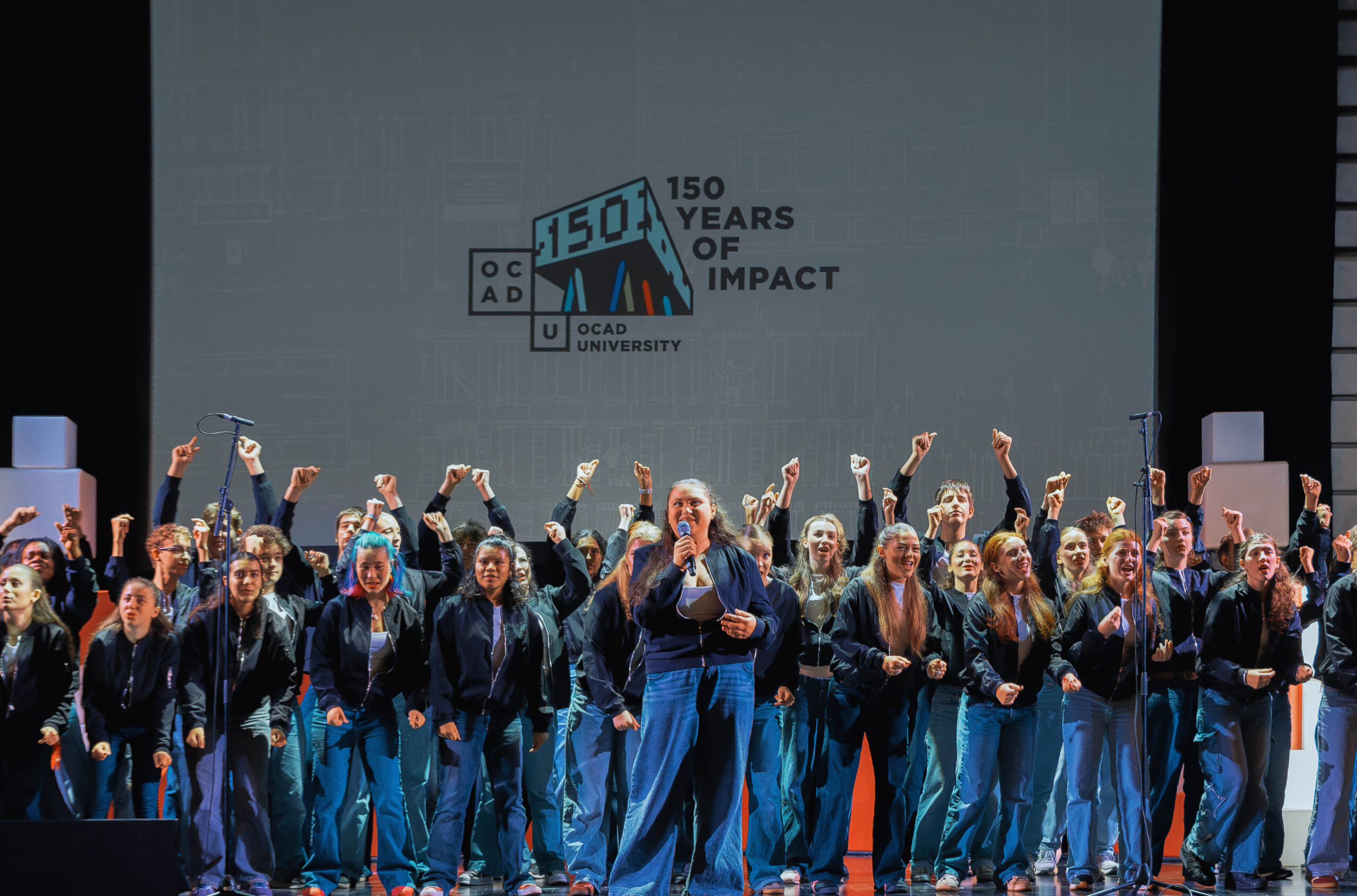
OCAD University celebrates 150 years of shaping Canadian culture
Art and design university launches $6-million campaign for 150 scholarships to mark 150th anniversary.
-

B.C. higher education: tweak or reform?
In the coming provincial election, parties offer different proposals for a system under strain.
-

Canada ‘muddling through’ without national research infrastructure strategy, panel finds
Expert report says fragmented governance and funding threaten Canada's research competitiveness and scientific sovereignty.
More from Artificial intelligence
-

Faculty well-being in the age of GenAI
When every student has an AI assistant, the writing teacher's job becomes both harder and more essential.
-

Can you spot an essay written by AI?
Learn the common patterns, limitations, and clues that may reveal AI-generated writing.
-

Gen Z meets genAI
We are the first generation to learn alongside AI. What do we owe the next?
-
AI in universities: the case in favour
Joël Blit argues integrating AI into curricula and pedagogy can make universities more human, not less.
More from Articles
-

Ottawa won’t restrict student visas from countries with high asylum-claim rates
India will help Canada ‘crack down’ on student program abuses, high commissioner says.
-

Students and seniors under the same roof
Intergenerational living helps with loneliness and the high cost of rent.
-

U Sports alum lace up for PWHL season
Canadian grads eager to show their mettle on women’s pro hockey teams.
-

The hidden problem of student homelessness
As high rents push more students into precarious housing, it's time to stop romanticizing the 'poor scholar'.

Post a comment
University Affairs moderates all comments according to the following guidelines. If approved, comments generally appear within one business day. We may republish particularly insightful remarks in our print edition or elsewhere.