Report ranks Canada fifth in the world for higher education
Research quality, academic integrity and global standing contribute to top-5 result.


A new analysis ranks Canada’s research and post-secondary system fifth in the world, behind the U.K. and the U.S., but ahead of other G-7 countries including Germany, France and Japan.
The report issued this week by measuresHE — a company that specializes in higher education analytics research — ranked the higher education systems of more than 100 countries based on research, sustainability, openness, international integration, global standing, demographics and investments, and academic integrity.
Canada’s fifth-place finish reflects not only the global standing and reputation of its top institutions, but an across-the-board strength in research, international integration, and academic integrity, according to the measuresHE analysis.
“Some countries, I would say China as [an example], have very high influence, and it’s got some top universities… but the average university isn’t that great. And I think you see the same thing in the United States,” said David Watkins, co-founder of measuresHE and former managing director of data at Times Higher Education. “Whereas, when you look at Canada, look at Australia, and at Western Europe in particular, those areas, there’s real strengths across the board, rather than weaknesses within the lower tiers of the university system.”
Canada’s overall score of 87.8 (out of a possible 100) put it just behind the fourth-ranked Sweden, at 88.1, third-ranked U.S., at 88.2, and second-ranked Netherlands, at 89.6. The U.K. came out on top with a score of 92.9.
Low investments pull down Canada’s score
Canada scored relatively low on the “demographics and investment” criterion, reflecting a relative deficiency in government and private-sector investment in higher education, said Billy Wong, co-founder of measuresHE and former principal data scientist at Times Higher Education.
“If we look at spending as a percentage of GDP, Canada only scores around 57 points, whereas the top four [countries] score about 70 points. So there is quite a bit of gap in there. The reason behind that, like so many other countries, is always domestic politics. What do the politicians prioritize?” Mr. Wong said.
He added that the “mix” of funding for universities — including government, industrial, and philanthropic sources — is “narrower” in Canada than in some other countries.
“Industry partnership is a little bit lower for Canada than it is for most of the rest of the top 10,” added Mr. Watkins. “Canada is a little bit behind in industry partnership, and typically that is reflected in industry funding as well.”
Research heavily weighted
The calculation of overall ranking was heavily weighted toward research quality, which accounted for 35 per cent of the overall score, and global standing, which accounted for 20 per cent. Global standing was based on the average rank of a nation’s top two institutions, as determined by Times Higher Education and QS, and by a measure known as “research gravitas,” which attempts to capture the weight and influence of published research papers.
Thanks to the high international rankings of McGill University and the University of Toronto, Canada scored 94.8 on the measure of global standing, which helped it to clinch fifth place. However, Mr. Watkins stressed, other measures within the overall calculation ensured that a country could not achieve a high ranking based on the performance of a few elite universities alone.
Canada also scored a full 100 points on academic integrity.
Teaching not part of rankings
One omission in the rankings lay in the area of teaching, which was not included in the calculation.
“There’s no really good publicly available data on this,” explained Mr. Watkins. “The research really is the lead indicator of the quality of the university. So that’s the main reason we really wanted to focus on the research side and not look too much at the teaching side.”
Mr. Wong added that teaching is “notoriously difficult to measure fairly across countries.”
While employment rate for graduates is often used as a proxy for teaching quality, this fails to take into account other factors, such as economic recessions and overall employment rates in different countries, he added.
“It is something that would be really interesting to look at. But until we have a way to measure that reliably across the world, it is better to stay away from it.”
Transparency in ranking criteria
Mr. Watkins, who launched measuresHE with Mr. Wong a year ago, said the company aims to provide transparency in its ranking methods. “All our data is open-sourced … and publicly available.”
The data that went into calculating the rankings came for the OpenAlex bibliometric database, as well as public sources including the UNESCO Institute for Statistics and the World Bank. Scores based on the data are adjusted for factors including national population and GDP, in an effort to rank each country on the quality of its educational and research system, not merely its size.



Featured Jobs
- Toldo Chair in Christian StudiesAssumption University
- Psychology - Assistant Professor (Clinical Psychology)Western University
- Movember Institute Discovery Research Program FellowshipsThe University of British Columbia
- International Studies - Faculty Position (Arctic Defence and Security)Université Laval
- Global Inequalities and Trade - Faculty PositionUniversité Laval
More from News
-

Ottawa won’t restrict student visas from countries with high asylum-claim rates
India will help Canada ‘crack down’ on student program abuses, high commissioner says.
-

Students and seniors under the same roof
Intergenerational living helps with loneliness and the high cost of rent.
-

U Sports alum lace up for PWHL season
Canadian grads eager to show their mettle on women’s pro hockey teams.
-

The hidden problem of student homelessness
As high rents push more students into precarious housing, it's time to stop romanticizing the 'poor scholar'.
More from Research
-

How serendipity built a cross-disciplinary career
Taking research positions out of economic necessity allowed me to gather a broad set of skills and knowledge.
-

Science in French? Bien sûr!
As English dominates the publication landscape, support for French-language research is a strategic investment in the quality, equity and the future of knowledge.
-

From doctoral student to entrepreneur
Resources abound to help you turn your PhD research into a business startup.
-
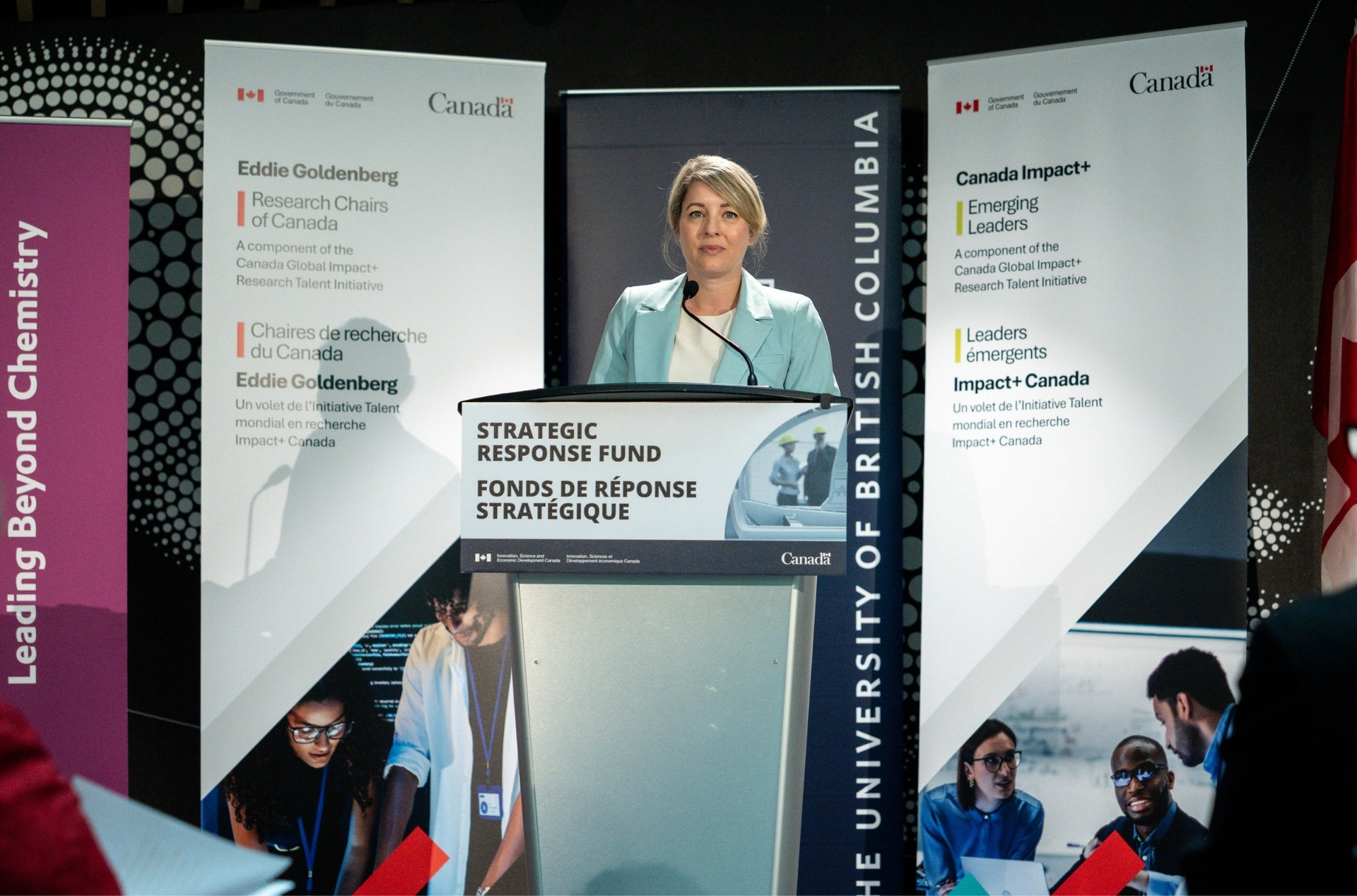
Ottawa announces 64 new research chairs in international talent attraction strategy
Top-tier researchers from 13 countries to join Canadian universities in first wave of appointments.
More from Articles
-

Parliamentary committee urges stronger support for research in French
Granting agencies should consider funding targets specifically for French-language projects, the Standing Committee on Science and Research recommends.
-

Remove EDI from research funding decisions, parliamentary committee says
The Standing Committee on Science and Research says ‘discriminatory’ EDI policies are ‘weakening the quality of Canadian research’.
-

Good medicine: new programs train country doctors
Université de Montreal follows Queen’s prescription to heal the shortage of family physicians in rural areas.
-

Universities struggle to be heard in Quebec election
In a campaign dominated by the U.S. trade war and the soaring cost of living, universities assert their continued importance.

Post a comment
University Affairs moderates all comments according to the following guidelines. If approved, comments generally appear within one business day. We may republish particularly insightful remarks in our print edition or elsewhere.
5 Comments
Hard to believe the US is higher than Canada (or any of the top 4 other countries), and I suspect that with the current administration’s cutting of research budgets at all levels and general distrust of higher learning, it’s standing will plummet in the coming year.
University of British Columbia rated a mention here. Canada has three, not just two, preeminent universities (as every credible global ranking tells us). And these are regionally diverse.
I like the headline. We look great, then read that teaching was not even considered in giving rankings. So for most of us basically useless study.
Any ranking that has Australian universities in the top 20 is questionable to say the least. Australia is where corporations pushed out of Europe and the US for unethical sales practices have set up shop and surreptitious privatization is nearly universal there. Several universities there have ended lectures altogether. Canada having a firewall between industry funding and research is a primary protection for research and educational integrity. Industry funded research builds conflicts of interest into science and normalizes them. This fundamentally weakens science as researchers seek to please the funders and research is directed and funded to advance profit interests rather than the public interest. It’s like Phillip Morris funding cigarette research showing smoking js good for you or BP funding research denying global heating. Corporations can fund their own R & D and research funds should not be siphoned off from the public sector and interest to enrich shareholders.
Another biased index.
In terms of research, the US remains at the top, by far. American scholars have more Nobel prizes (425 over the past century) than the next five nations combined (UK, Germany, France, Sweden, and Japan. Russia, Canada, and Switzerland round out the top 10). While there have been substantial cuts by the Trump team, the American research capacity is still massive, and the funding cuts have been targeted. Ranking the US 5th in Research, and behind Canada (etc.), is not defensible.
The peculiar inclusion of only the top two national universities benefits the UK since it provides the focus on Oxford and Cambridge (suggesting a bias by the responsible British group, THE). While these two are consistently in the top ten, most of the others top universities are American. Broader consideration would strongly favor the US.
The International index also favors the European nations. The EU population (~450m) is fairly similar to that of the US (~350m), and some EU nations might be regarded as equivalent to American states. A Swedish project that includes colleagues from neighboring Norway would be international, while an American collaboration involving scholars from CA, TX, and MA wouldn’t, even though there are greater differences in geography and perhaps in research culture. Canada does fairly well on this index since we often collaborate with Americans, or others.
I think that Canada could be in the top 10 but below 5th.