Ottawa announces 64 new research chairs in international talent attraction strategy
Top-tier researchers from 13 countries to join Canadian universities in first wave of appointments.
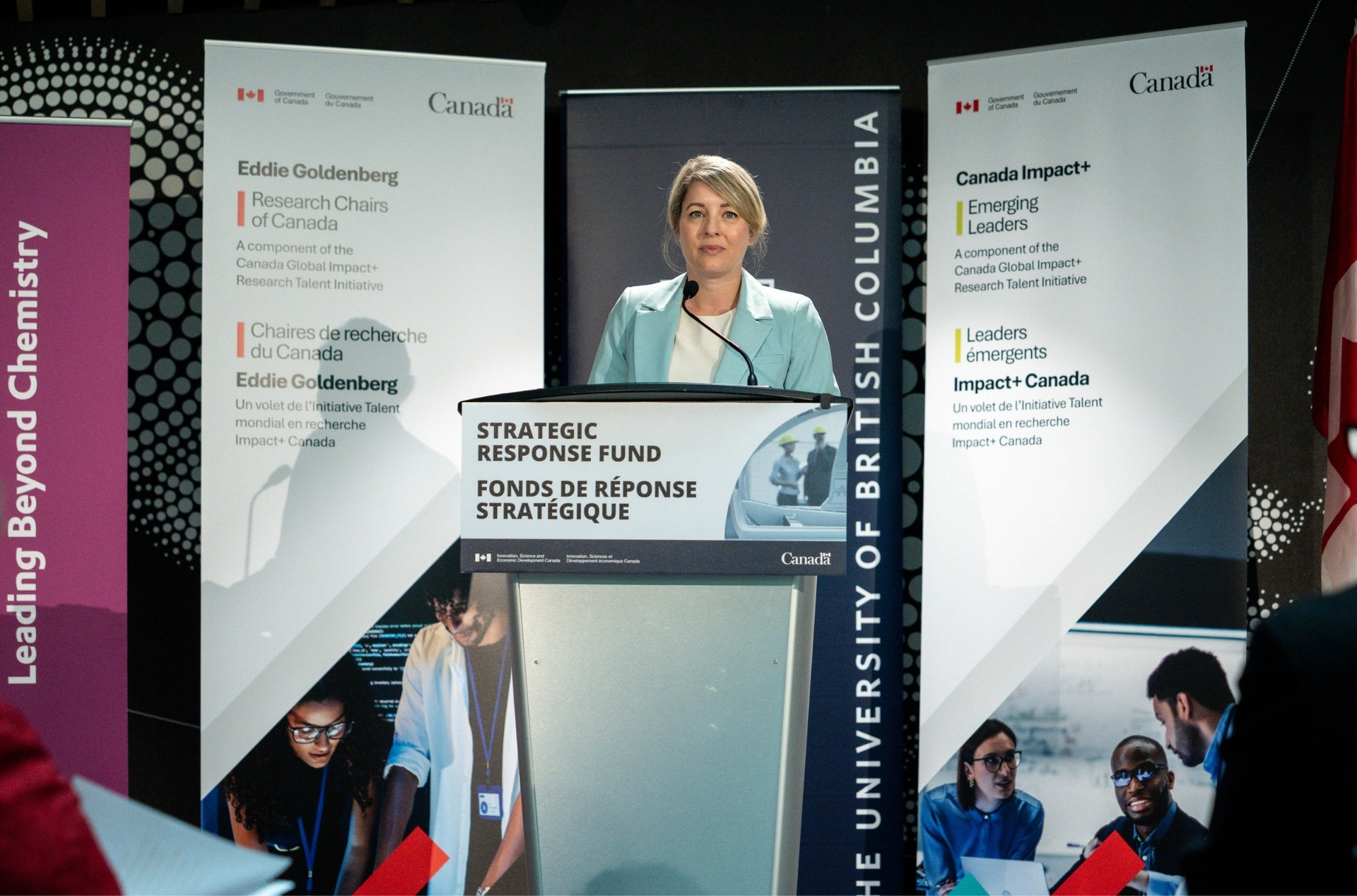
Sixty-four globally recognized scholars have been named the first recipients of the federal government’s new Eddie Goldenberg Research Chairs of Canada program, backed by $504 million in funding over eight years.
See the full list of Research Chair recipients.
The chairs are the first of 100 positions that will form the centrepiece of the government’s $1.7-billion Canada Global Impact+ Research Talent Initiative, initially announced by Industry Minister Mélanie Joly in Dec. 2025.
The highly competitive award provides 60 Research Chairs with either $500,000 or $1 million annually for an eight-year term, along with additional support to hire postdoctoral fellows and invest in research infrastructure. In addition, four Distinguished Research Chairs of Canada will each receive $1.5 million annually for eight years.
“This investment in long-term, sustained research programs is unique among anything I’ve seen,” says Katy Backes Kozhimannil, an American public health researcher who accepted a chair position at the University of Calgary.
The chairs were selected for their potential to build research capacity in areas Ottawa has identified as critical for Canada’s future, from Arctic governance and community resilience to quantum technology and maternal health.
“Attracting top talent will deliver breakthroughs that improve Canadians’ lives,” said Minister Joly. “By expanding Canada’s talent pipeline and research capacity in areas that are vital to our prosperity and sovereignty, we are helping build the strongest economy in the G7.”
Most chairs headed for U15 universities
The first intake of research chairs, who come from 13 countries and will begin their programs in July 2027, is spread across 21 institutions. Fifty-four have accepted positions at U15 universities, Canada’s leading research-intensive institutions, with UBC receiving the most (nine), followed by the University of Ottawa (seven), and McGill University and the University of Toronto (six each).
Robert Asselin, CEO of U15 Canada, says the announcement demonstrates what can be achieved when universities are empowered to compete for world-class talent and represents “an investment in the future success of a sovereign Canada.”
For incoming researchers, the scale and duration of the funding offer an opportunity to build ambitious programs over the long term.
Julie Lockwood, who will join McGill University from Rutgers University as the Eddie Goldenberg Research Chair of Canada in Climate-Smart Invasive Species Science, says the position will allow her to work on the front lines of climate research in an environment that recognizes the seriousness of biodiversity conservation, ecosystem management and climate change.
“Accepting this position allows me to create a world-beating research program in one of the fastest-growing environmental challenges in the world,” says Dr. Lockwood.
She plans to leverage existing investments from the Quebec and federal governments to develop applied solutions to address climate change. “We need to be bold and innovative in our solutions,” she says, “and that’s what this position allows me to lean into.”
For Dr. Backes Kozhimannil, who will become the Eddie Goldenberg Research Chair of Canada in Maternal and Child Health Policy, the move offers an opportunity to apply expertise gained in the United States to a new health-care system.
Her research focuses on access to maternity care, particularly in rural and remote communities, and she is looking forward to learning “what’s possible in the Canadian context,” she says. “We have very different health care systems in Canada and the U.S., but some of the same challenges in rural communities, and some of the same health equity challenges.”
Dr. Backes Kozhimannil says she hopes to “amplify” the work of the “brilliant researchers” at the University of Calgary’s Centre for Health Policy.
U.S. instability drives scholars to Canada
The federal government and Canadian universities have moved quickly to roll out a program of this scale, in part to attract scholars whose research has been threatened by funding instability, policy changes and political interference in the U.S. following President Donald Trump’s re-election in 2024. Most of the 64 researchers in the first cohort hail from U.S. institutions, an influx touted as a “brain gain” for Canada.
Daniel Kreiss is among them. He will leave the University of North Carolina at Chapel Hill to join the University of British Columbia as the Eddie Goldenberg Research Chair of Canada in Democratic Communication.
Dr. Kreiss plans to use the position to conduct comparative research on global patterns of democratic backsliding and translate findings for policymakers and the public.
He says the chairs are “transformative in terms of research programs,” not only because they provide the resources to conduct cutting-edge research, but because they affirm the importance of higher education and science globally.
“That means not politicizing the process of science … not weaponizing it.” Canada, he says, “very much values the integrity of the scientific process and academic freedom and peer review.”
Chloé Arson, who was named Eddie Goldenberg Research Chair of Canada in Subsurface Energy Systems and Geomechanics at McGill University, says the political and scientific climate in the U.S. motivated her to accept the position in Canada.
“At present there is no large-scale funding for projects like mine,” she says. “A country cannot develop without intellectual independence, scientific independence and academic independence, which then translate into technological progress that is implemented at the economic and social levels.” Originally from France, her looks forward to pursuing her career in a francophone province.
Dr. Arson’s focus is green energy, one of Ottawa’s strategic priorities. “The population is growing. We need more energy. How can we consume energy differently?” she asks. “Perhaps we can link certain forms of green energy with other technologies in order to reduce carbon dioxide emissions.”
The announcement also includes $37 million to recruit 63 Impact+ Emerging Leaders over the next year. The early-career researchers will receive awards worth $100,000 annually for six years. The program is part of the broader Impact+ initiative’s goal of bringing 1,000 highly qualified researchers into Canada’s research ecosystem.
| Chairholder | Eddie Goldenberg Research Chair of Canada in | Institution |
| David Almedia | Daily Mental Health and Well-Being Science | University of Victoria |
| Aram Amassian | AI-driven discovery and manufacturing of emerging semiconductors for technological sovereignty | École Polytechnique de Montréal |
| Michelle Arkin | Chemical Biology | University of Toronto |
| Chloé Arson | Subsurface Energy Systems and Geomechanics | McGill University |
| Keith Baar | Musculoskeletal Longevity | McMaster University |
| Tanya Berger-Wolf | AI for Nature | University of Toronto |
| Talia Bettcher | Gender-Based Violence Prevention and Trans Community Resilience | University of Waterloo |
| Philomena Bluyssen | Indoor Environmental Quality for Healthy Living | Toronto Metropolitan University |
| Gabriel Bowen | Applied Isotope Science | University of Ottawa |
| Adrienne Campbell-Washburn | Medical Imaging Technology | University of Toronto |
| Peter Caravan | Translational Molecular Imaging and Therapy | The University of British Columbia |
| Jan Carmeliet | Urban Climate | Université de Sherbrooke |
| Patrick Charbonneau | Physics of Complex Materials and Artificial Intelligence | Université de Montréal |
| Charles Chen | Adaptive Genomics for Climate-Resilient Forestry and Agriculture | University of Alberta |
| Yingda Cheng | Advanced Digital Technologies for Fusion Energy | Simon Fraser University |
| Raymond Fisman | Finance and Political Economy | University of Toronto |
| Tomislav Friščić | Mechanochemistry and Solid-State Chemistry | McGill University |
| Patricia Garcia | Diagnostic Systems for Health Equity: From Discovery to Delivery | University of Manitoba |
| Sanket Goel | Translating Cyber Physical Sensory Systems to Reimagine Health and Prosperity | University of Manitoba |
| Seth Guikema | Climate Risk and Resilience Analytics | Western University (The University of Western Ontario) |
| Kevin Hall | Eddie Goldenberg Research Chair of Canada in Nutrition and Metabolic Health | University of Ottawa |
| Elliott Hazen | Climate Resilience and Ocean Futures | University of Victoria |
| Christopher Hittinger | Biodiscovery, Biodesign, and Bioproduction | University of Guelph |
| Curtis Huttenhower | Microbiome Sciences | The University of British Columbia |
| Peter Jackson | Intelligence and Security in a Changing Global Order | University of Calgary |
| Shu (Joy) Jiang | Translational Digital Health | University of Toronto |
| Ajit Khosla | Real-World AI Driven Turnkey Systems for Environmental Intelligence | University of Regina |
| Crystal Kolden | Wildfire Resilience | The University of British Columbia |
| Katy Backes Kozhimannil | Maternal and Child Health Policy | University of Calgary |
| Daniel Kreiss | Democratic Communication | The University of British Columbia |
| Brian Kuhlman | Computational Protein Design | The University of British Columbia |
| Donald Lafreniere | Community Geography | Trent University |
| Suzanne Lapi | Isotope Production and Radiopharmaceutical Innovation | McMaster University |
| James LeBeau | Quantitative and AI-Enabled Electron Microscopy for Quantum and Advanced Materials | McMaster University |
| Julie Lockwood | Climate-Smart Invasive Species Science | McGill University |
| Sheryl Magzamen | One Health and the Impact of Environmental Factors on Vulnerable Populations | Université de Montreal |
| Jonathan McConathy | Molecular Imaging and Nuclear Theranostics | McMaster University |
| Ryan McNeil | Equity-Oriented Responses to the Drug Toxicity and Housing Crises | University of Ottawa |
| Sophie Mitra | Health Equity and Economic Well-Being | Université Laval |
| William John Munro | Scalable Quantum Network Infrastructure | University of Calgary |
| Julian Olden | Freshwater Ecosystem Sustainability | The University of British Columbia |
| Igor Polyakov | Arctic Physical Oceanography | University of Manitoba |
| Peter Reiners | Geoscience of Subsurface Fluid-Rock Systems for Solutions in Sustainability and Security | University of Manitoba |
| Benjamin Richardson | Climate, Environment and Property Law | University of Manitoba |
| Federico Rosei | Emerging Sustainable Materials for the Energy Transition (ESMET) | University of Ottawa |
| Kazuhiro Saitou | Engineering Design | The University of British Columbia |
| Sara Seager | Planetary and Molecular Sensing Technologies | University of Toronto |
| Susan Shaheen | Sustainable Transportation Futures | University of Alberta |
| Olga Smirnova | Ultrafast Chirality for Health, Environment, and Quantum Technologies | University of Ottawa |
| Martin Solan | Resilient Cold Ecosystems | Université Laval |
| Sameer Sonkusale | Eddie Goldenberg Research Chair of Canada in Health Technology Innovation | McGill University |
| Jennifer Spence | Arctic Governance and Community Resilience | University of Ottawa |
| Francois St-Pierre | Optical Protein Engineering and Biophotonics | Université Laval |
| Ryan Sullivan | Environmental and Sustainable Chemistry | Trent University |
| Jonathan Wakefield | Eddie Goldenberg Research Chair of Canada in Bayesian Space Time Modeling for Global Health | The University of British Columbia |
| Gabriel Walton | Eddie Goldenberg Research Chair of Canada in Slope Geohazard Management for Infrastructure and Mining in a Changing Climate | Queen’s University |
| Ruibing Wang | Supramolecular Biomaterials | University of Waterloo |
| Kathryn Whitehead | Eddie Goldenberg Research Chair of Canada in Translational Drug Delivery | The University of British Columbia |
| James Wolffsohn | Health Innovation | University of Waterloo |
| Ipek Yalcin | Chronic Pain and Emotional Dysregulations | Université Laval |
| Cassian Yee | Next-Generation Translational T Cell Immunotherapies | University of Ottawa |
| Phillip Zamore | Eddie Goldenberg Distinguished Research Chair of Canada in RNA Biology and Therapeutics | McGill University |
| Charlene Zietsma | Catalyzing Ecosystems for Sustainable Futures | McMaster University |
| Ethan Zuckerman | Eddie Goldenberg Research Chair of Canada in the Digital Public Sphere | McGill University |




Featured Jobs
- International Studies - Faculty Position (Arctic Defence and Security)Université Laval
- Global Inequalities and Trade - Faculty PositionUniversité Laval
- Psychology - Assistant Professor (Clinical Psychology)Western University
- Director, Human Research Ethics & Strategic AdvisorUniversity of Manitoba
- Theatre and Film - Assistant Professor Without Review (Performance Practice)The University of British Columbia
More from News
-

U Sports alum lace up for PWHL season
Canadian grads eager to show their mettle on women’s pro hockey teams.
-

The hidden problem of student homelessness
As high rents push more students into precarious housing, it's time to stop romanticizing the 'poor scholar'.
-

Parliamentary committee urges stronger support for research in French
Granting agencies should consider funding targets specifically for French-language projects, the Standing Committee on Science and Research recommends.
-

Remove EDI from research funding decisions, parliamentary committee says
The Standing Committee on Science and Research says ‘discriminatory’ EDI policies are ‘weakening the quality of Canadian research’.
More from Research
-

Science in French? Bien sûr!
As English dominates the publication landscape, support for French-language research is a strategic investment in the quality, equity and the future of knowledge.
-

From doctoral student to entrepreneur
Resources abound to help you turn your PhD research into a business startup.
-
A look inside the hive: celebrating honey bee research at two Canadian universities
As MacEwan University marks 10 years of bees on campus, the University of Guelph kicked off the year by unveiling its newest centre for honey bee research.
-

Canada needs a national strategy to protect scholars at risk
Supporting displaced academics is a strategic investment in Canada's research and innovation ecosystem.
More from Articles
-

Good medicine: new programs train country doctors
Université de Montreal follows Queen’s prescription to heal the shortage of family physicians in rural areas.
-

Universities struggle to be heard in Quebec election
In a campaign dominated by the U.S. trade war and the soaring cost of living, universities assert their continued importance.
-

Quebec’s English-language universities embrace new French requirements as fall cohort begins
McGill, Concordia and Bishop’s universities roll out new initiatives to encourage students to learn French on and off campus.
-
Attacks on higher education spread globally, including in liberal democracies, Scholars at Risk report finds
Canada urged to defend values amid erosion of institutional autonomy in the U.S.


Post a comment
University Affairs moderates all comments according to the following guidelines. If approved, comments generally appear within one business day. We may republish particularly insightful remarks in our print edition or elsewhere.
1 Comments
Thank you for sharing.