When the accommodation stops at the campus gate
When students with disabilities enter mandatory work placements, the accommodations they depend on can disappear when the stakes are highest.


A student with a disability may spend years in an environment where accessibility is understood and supported: working with an accessibility office, establishing accommodations, and developing strategies to demonstrate their abilities alongside their peers.
Then comes the mandatory placement.
The student enters a hospital, school, a veterinary clinic, or social service agency. Their accommodation plan may not follow them. The supervisor may know little about disability accommodation. The university remains responsible for the educational programme but has limited control over the workplace.
And the student, whose professional future may depend on a favourable evaluation, must navigate the gap between them.
Two institutions, no clear accountability
Whether practicums, clinical rotations, or internships, placements are often mandatory components of professional programmes. Yet the accessibility arrangements governing classroom learning may not extend to the workplace.
Universities retain obligations under applicable human rights law. Placement hosts may have their own accommodation obligations, depending on the relationship and governing legislation. Those responsibilities are not always clearly allocated.
The university may assume the host will address accommodation; the host may assume the university already has. Neither assumption guarantees access.
A failed placement can mean delayed graduation, added tuition, lost income or exclusion from a profession. The consequences fall on the person with the least authority to resolve them.
When disability becomes a performance problem
The risks are acute for students with non-apparent disabilities, including neurodivergent students.
A student who avoids sustained eye contact may be described as disengaged. One who needs written instructions may be criticized for failing to listen. Another who requires processing time may be labelled slow or unable to function under pressure.
These observations do not necessarily establish an inability to meet essential professional requirements. They may instead reflect narrow assumptions about how competent professionals should communicate or behave.
Yet such impressions become formal evaluations. Comments about attitude, initiative, or professionalism may determine whether a student passes, receives a reference, or progresses toward accreditation.
When disability-related differences are mistaken for competence deficiencies, discrimination can be reproduced under the guise of professional judgment.
Is eye contact essential to effective client communication? Must instructions be received verbally to demonstrate sound judgment? Can the same professional standard be achieved differently?
These are questions about essential requirements, not preferential treatment.
The disclosure dilemma
A student who discloses a disability to a university accessibility office does so within an established process. A placement introduces a different relationship.
The student may need to disclose accommodation requirements to an unfamiliar supervisor who assesses their performance and may influence future employment opportunities.
Students may worry about being seen as difficult, less capable, or unsuitable. Some decide not to disclose.
When difficulties arise, what could have been addressed through accommodation may instead be recorded as evidence of professional inadequacy.
Students should not have to choose between protecting their privacy and protecting their academic future.
Supervisors cannot know what nobody taught them
Placement supervisors are selected for professional expertise, not knowledge of disability law or inclusive education.
An experienced lawyer may know little about accommodating hearing loss. A clinical supervisor may be unfamiliar with neurodivergent communication. A social worker committed to equity may still rely on conventional workplace expectations.
Too often, supervisors are never taught to distinguish between essential professional requirements and traditional ways of meeting them.
A social work student must demonstrate sound judgment, but that does not necessarily require processing every instruction immediately. A pharmacy student must communicate effectively, but that does not mean every meeting must depend on hearing. A nursing student must meet legitimate patient-safety requirements, but those requirements should be identified and assessed, not invoked broadly to dismiss accommodation.
Accommodation does not mean lowering professional standards. It means determining whether the method of demonstrating those standards creates an unnecessary barrier.
Make accessibility a condition of placement
Universities must build accessibility into placement arrangements before problems emerge.
Programmes should document essential placement requirements, distinguishing genuine professional competencies from customary practices that can be modified without compromising standards.
Placement agreements should identify accommodation responsibilities. Students should be offered confidential pre-placement conversations with university coordinators and host supervisors, focused on practical arrangements rather than unnecessary medical disclosure.
Supervisors need brief training in inclusive supervision and fair assessment. Students need an independent route to raise concerns, not one through the person evaluating them.
But the fundamental question is this: Why should a university approve a mandatory placement site without establishing that the host can meet its accessibility responsibilities?
Universities already assess placement suitability through supervision, professional standards, and learning opportunities. Accessibility should be part of that assessment, not an afterthought.
A host need not anticipate every accommodation. It should demonstrate the capacity to provide accessible education.
The campus gate is not the boundary of inclusion
As a disability rights lawyer who has taught Disability Law at Toronto Metropolitan University and Western University, and Law and Social Work at Dalhousie University, I understand how professional education shapes the assumptions graduates carry into their careers.
My work has long examined accommodation in education and employment. Yet the transition between them deserves greater scrutiny: the moment when students move into professional placements and discover that the supports they relied upon do not necessarily follow.
Through a lifetime of profound hearing loss, I also know how easily communication differences can be mistaken for limitations in ability.
Professional placements are not incidental experiences outside the educational programme. They are part of the programme itself, often among its most consequential components.
A university cannot claim to provide accessible education while treating the environment where students complete it as someone else’s responsibility.
The question is not whether students with disabilities can meet professional standards. It is whether universities and placement hosts have distinguished those standards from barriers they themselves have created.
Accessibility cannot stop at the campus gate when the education does not.



More from Career Advice
-

How to develop a teaching-focused career at Canadian post-secondary institutions
Diverse paths, shared wisdom.
-
Thinking about Harvard?
The Frank Knox Fellowship could fund your graduate studies.
-
Finding my family in retirement
Academic research experience comes in handy when tracking down ancestral geneaology.
-

How to get published when your reviewers don’t get it
New theoretical approaches often encounter editorial skepticism.
More from Accessibility
-

An accessible campus is only part of a university’s responsibility
Universities must embed disability knowledge into core professional learning.
-

Neurodiversity in Canadian postsecondary education
More support and recognition needed according to Conference Board of Canada report.
-

Bridging gaps and building opportunities
How growing recognition of the diverse needs of students on the autism spectrum is fueling a culture change on campus.
-
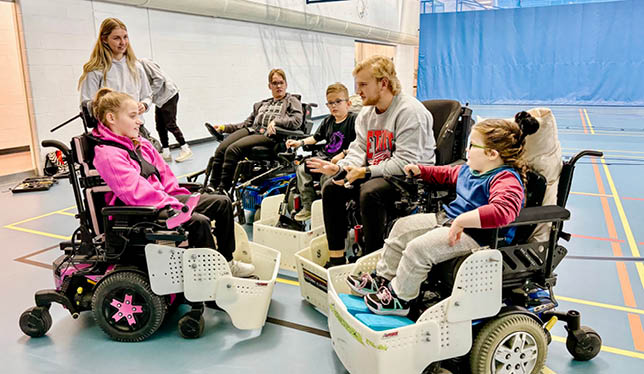
University of Lethbridge student creates powerchair soccer league
Chase Petruska hopes the league will have a positive impact on the mental health of participants.
More from Career Advice Articles
-

How serendipity built a cross-disciplinary career
Taking research positions out of economic necessity allowed me to gather a broad set of skills and knowledge.
-
Internationalizing Truth And Reconciliation through multilingual storytelling
Faculty share stories in their home and heart languages in the University of the Fraser Valley’s Leq'áleq’el Video Series.
-

Can you spot an essay written by AI?
Learn the common patterns, limitations, and clues that may reveal AI-generated writing.
-

The secret to good labour relations
Two negotiators — one from a faculty association, one from a university administration — share their advice for building trust and achieving the common good.
Post a comment
University Affairs moderates all comments according to the following guidelines. If approved, comments generally appear within one business day. We may republish particularly insightful remarks in our print edition or elsewhere.