Universities Canada, CAUBO warn federal action is needed as Canada’s universities face worsening financial outlook
A coordinated immigration policy, tax relief and fiscal crisis safeguards are recommended to sustain sector.
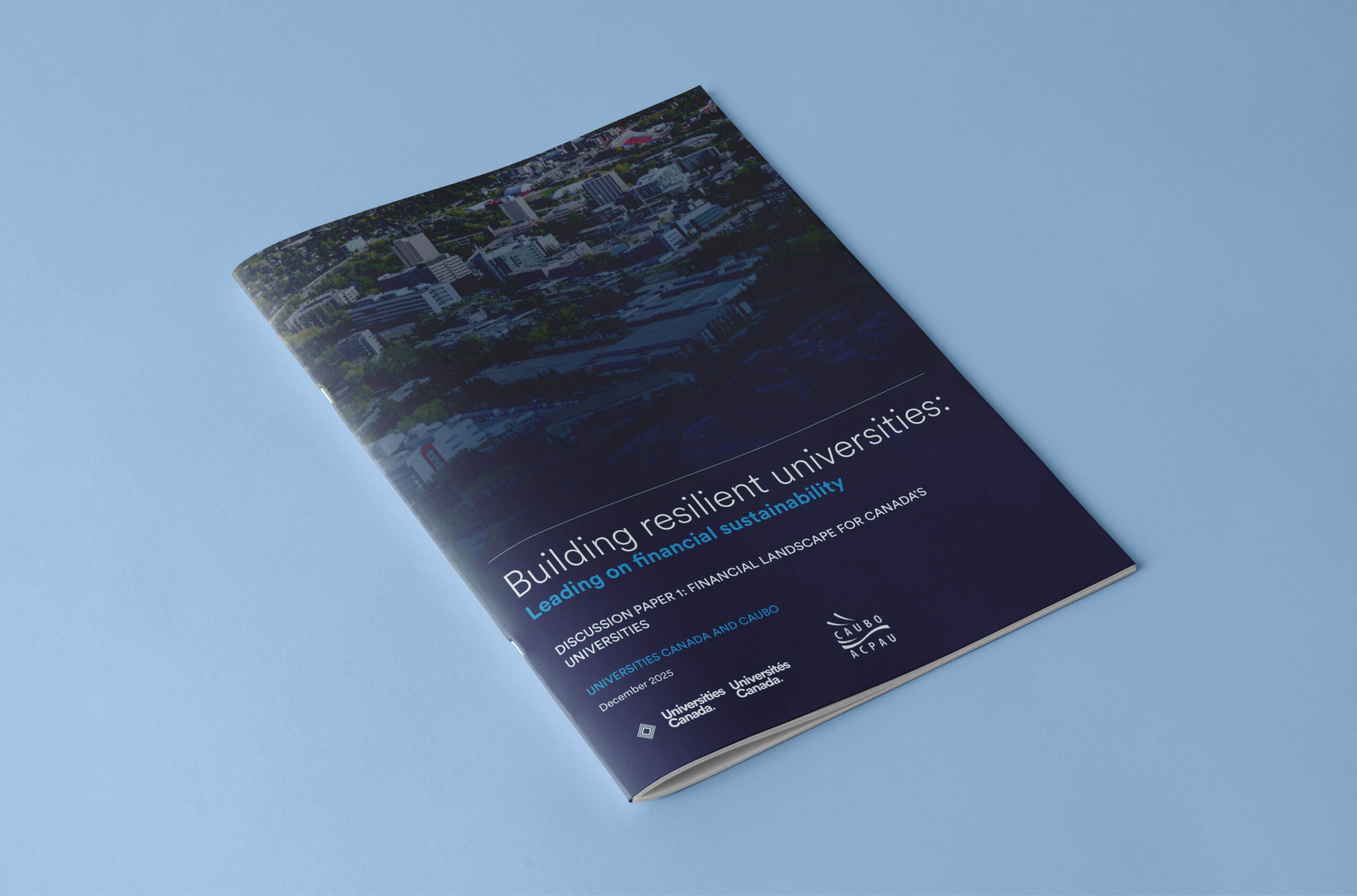
A report published today warns of a deteriorating financial outlook for the country’s public post-secondary institutions and recommends priority federal interventions for sector stability.
The report, “Building resilient universities: leading on financial sustainability,” prepared by Universities Canada (University Affairs’ publisher) in collaboration with the Canadian Association of University Business Officers (CAUBO), portrays a system under immense strain. Years of underfunding, rising operating costs, aging infrastructure, policy uncertainty and expanding regulatory requirements have, the authors argue, left universities with diminished capacity to respond to shifting labour market demands, demographic changes and rapid technological advancement.
“This report comes at a critical moment for Canada’s university system. Over the past decade, public funding per student has declined while costs have continued to rise, and institutions have very limited flexibility to respond,” said Nathalie Laporte, CAUBO’s executive director.
Ms. Laporte added that financial pressures on universities are “no longer abstract” for those working in the sector who have seen resources stretched thin, larger class sizes, program closures and constrained research capacity. “The report is needed now to clearly lay out these realities and to identify practical steps to stabilize the system and protect its core academic mission.”
Although many of the structural challenges facing universities fall within provincial jurisdiction, the authors point to federal policy levers that could play a decisive role in easing immediate financial stress.
One opportunity is through tax policy. The report recommends Ottawa increase the federal GST/HST rebate for universities to 100 per cent, aligning it with the rate available to municipalities and designated municipal service providers. Raising the rebate from its current level of 67 per cent would provide an estimated $240 million across the sector in annual savings, according to the report. Gabriel Miller, president and CEO of Universities Canada, described the tax adjustment as a matter of common sense.
“When these institutions are under the gun, does it really make sense for them to be using student tuition and government subsidies to pay sales tax to the federal government? I don’t think so,” he said.
The second major recommendation is for government departments to adopt a more coordinated national approach to talent, skills and immigration policy that will align with economic and regional workforce priorities and remove barriers that prevent talent from coming to Canada. The report’s authors emphasized the risks of sector stakeholders working in silos, particularly in the wake of recent federal immigration policies, most notably the international student visa cap implemented in 2024.
A recent auditor general report on the changes to the international student program pointed specifically to Immigration, Refugees and Citizenship Canada’s failure to take into consideration the needs of smaller provinces when rolling out the nationwide policy, despite its mandate to do so and provincial efforts to recruit and retain foreign students to compensate for a shrinking population.
“We can’t have federal and provincial governments pursuing contradictory policies in terms of which parts of the country we’re trying to draw people to or what talent we need,” said Mr. Miller. “You have to line up your research investments, your global marketing and your immigration policies so you’re sending a strong message to the world that we want to attract the best and the brightest.”
Lastly, the authors are calling for federal safeguards to be put into place to protect universities in financial crisis that may be left to either cease operations entirely or require a complex and costly provincial bailout, the report reads.
Federal legislation, Bill C-59, which received royal assent in June 2024, amended the Bankruptcy and Insolvency Act and the Companies’ Creditors Arrangement Act to bar applications from public post-secondary institutions. Laurentian University in Sudbury, Ont., became the first public university in Canada to seek CCAA protection in 2021 when it used the process to stay creditor claims while it cut costs, closed programs and reorganized finances.
Universities Canada and CAUBO say post-secondary leaders must now advocate for a “safety net” that will protect students, research and communities. This could include a “viable, sector-specific alternative” to the CCAA, or a mechanism for “orderly, transparent, court-supervised restructuring that balances public accountability with institutional autonomy,” the report noted.
Ms. Laporte says that the report, which is currently in discussion amongst sector stakeholders at Universities Canada’s annual membership meeting in Vancouver, will be used as a starting point “for the coordinated action that needs to follow.”
Risks for the sector going forward
Beyond the immediate financial pressures universities are confronting, the report identifies long-term risks that could further jeopardize sector viability.
Demographic trends — including a growing youth population and an aging workforce — will increase pressure on universities to expand while maintaining quality. Statistics Canada projects that, if current enrolment trends continue, Canada could see an additional 218,000 to 488,000 university students by 2040.
At the same time, Canada’s aging population is projected to lead to labour shortages, as older workers retire, putting increased pressure on the healthcare system. Between 2022 and 2031, Canada is forecasted to see nearly 8 million job openings – mostly due to retirements – and two-thirds will require post-secondary education or management experience, according to the report. The greatest impacts are expected in rural regions and provinces with aging populations such as Newfoundland and Labrador, Nova Scotia and New Brunswick.
The report also points to risks for Canadian communities that rely on universities as employers and research and talent providers. Further reductions in funding will lead to more job losses and negative consequences for local economies.
Still, Mr. Miller says there is optimism among the post-secondary sector that the federal and provincial government, along with sector stakeholders and leaders, will be able to work together to mitigate the challenges ahead.
“We feel there is a government in Ottawa that wants to be part of the solution and we see in Prime Minister Carney someone who understands the importance of universities and why their contributions to Canadian life and our economy are so important,” he said.



Featured Jobs
- Director, Human Research Ethics & Strategic AdvisorUniversity of Manitoba
- Psychology - Assistant Professor (Clinical Psychology)Western University
- Toldo Chair in Christian StudiesAssumption University
- Global Inequalities and Trade - Faculty PositionUniversité Laval
- Canada Impact+ Emerging Leader in Quantitative and AI-enabled Electron Microscopy for Quantum and Advanced MaterialsMcMaster University
More from News
-
Feds announce $880 million for research
Funding will support both established health scientists and emerging cross-disciplinary researchers.
-

OCAD University celebrates 150 years of shaping Canadian culture
Art and design university launches $6-million campaign for 150 scholarships to mark 150th anniversary.
-

B.C. higher education: tweak or reform?
In the coming provincial election, parties offer different proposals for a system under strain.
-

Canada ‘muddling through’ without national research infrastructure strategy, panel finds
Expert report says fragmented governance and funding threaten Canada's research competitiveness and scientific sovereignty.
More from Budget
-
Ontario unis avoid fiscal abyss, still anticipate cuts
Universities relish a multi-billion-dollar provincial infusion, but budgeting remains frugal for 2026-27.
-

NL increases funding for post-secondary, confirms tuition freeze
Memorial University still faces “hard decisions” for upcoming operating budget.
-
$21 M allocation gives USudbury ‘a solid foundation to build on’
Provincial funding allows the northern Ontario university to continue operating after its breakup with Laurentian.
-
Ontario budget reaffirms $6.4 B post-secondary funding boost, adds money for infrastructure
Millions more allocated to research, clinical nursing training, and French-language education.
More from Articles
-

Ottawa won’t restrict student visas from countries with high asylum-claim rates
India will help Canada ‘crack down’ on student program abuses, high commissioner says.
-

Students and seniors under the same roof
Intergenerational living helps with loneliness and the high cost of rent.
-

U Sports alum lace up for PWHL season
Canadian grads eager to show their mettle on women’s pro hockey teams.
-

The hidden problem of student homelessness
As high rents push more students into precarious housing, it's time to stop romanticizing the 'poor scholar'.


Post a comment
University Affairs moderates all comments according to the following guidelines. If approved, comments generally appear within one business day. We may republish particularly insightful remarks in our print edition or elsewhere.
1 Comments
I can’t say enough about this new joint UnivCan/CAUBO report. It’s really important — crucial really.
That the report calls for an increase in funding with a decrease in government interference is truly historic.
Section G speaks volumes on how much has changed for the worse in certain provinces in Canada:
“G. Governance and autonomy pressures
…shifts in how governments engage with and attempt to influence university governance and operations. Even as public investment in universities has declined, governmental oversight and intervention have grown.
Institutional autonomy and the principle of academic freedom are necessary conditions for universities to pursue their institutional missions and create, preserve and disseminate knowledge based on evidence and peer review…” (p. 14).
It really must be highlighted how noteworthy this is and how it addresses our dangerous times as emboldened governments become more and more authoritarian.
Moreover, we now have every major sector in Canada- regardless of political stance- from administrators, financial officers, unions, bankers, to private consultants, and pundits- in agreement that universities are chronically underfunded and headed towards the brink of crisis.
Such a disparate cautionary chorus should be a harsh wake up call to governments of every level that the sector is in trouble and requires immediate action and support.