Critics mull challenge to Ontario’s Bill 33
Government regulation of student fees, admissions criteria, cause controversy around new provincial education law.
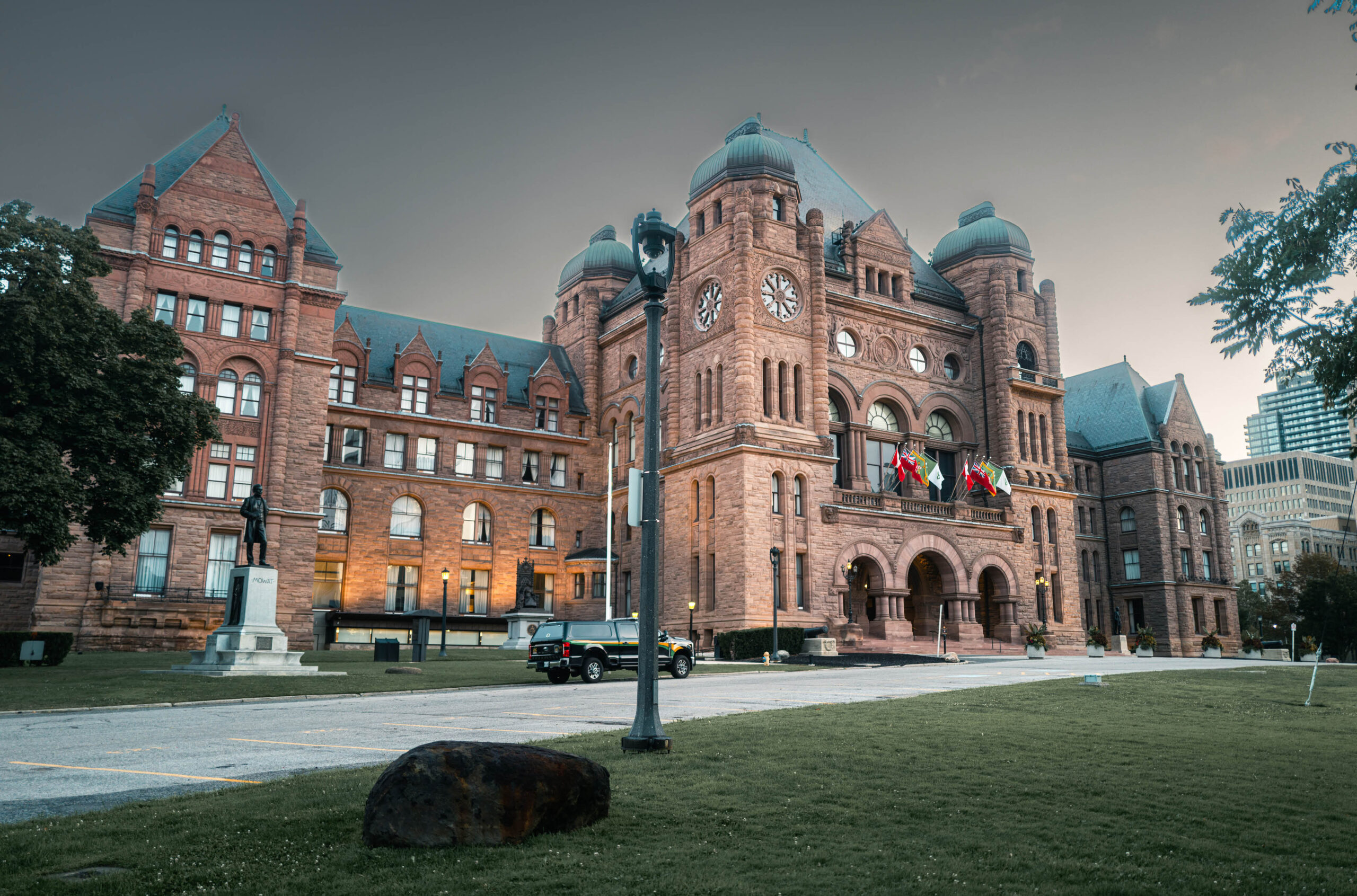
Critics of Ontario’s Supporting Children and Students Act are mulling a potential legal challenge — but will first wait to see how the province rolls out the new law, with its controversial provisions for merit-based admissions and government regulation of student fees.
First introduced in May under the title Bill 33, the omnibus bill received royal assent on Nov. 20. It has drawn wide condemnation from Ontario’s university sector, branded as an unnecessary overreach, a threat to university independence and a distraction from the system’s significant funding challenges.
“It’s probably the most horrendous intervention into university autonomy in the history of the province,” said Glen Jones, a professor of higher education at the University of Toronto’s Ontario Institute for Studies in Education.
But the government believes Ontario’s post-secondary students “deserve to know where their fees are going, what criteria they need for admission and how their research will be protected,” Bianca Giacoboni, press secretary for Minister for Colleges, Universities, Research Excellence and Security Nolan Quinn, said in an emailed response about the rationale for the bill’s post-secondary provisions. “This bill will ensure transparency and foster better trust in our postsecondary education system.”
Students to be admitted on ‘merit’
In addition to reforms affecting school boards and children’s aid services, the legislation requires colleges and publicly assisted universities to assess prospective students “on the merit of the individual applicant” and to publish their admissions criteria and process. The government can also issue regulations specifying the criteria and process to be used for assessing merit, as well as “exceptions” to merit-based assessment.
Ms. Giacoboni did not specifically address a question about what evidence her ministry had that would indicate students are not currently being admitted to Ontario universities based on merit. However, the introduction of Bill 33 followed criticism in the fall of 2024 of Toronto Metropolitan University’s planned admissions approach for its new medical school. TMU initially suggested it would reserve the majority of seats for students from historically underrepresented groups, but later clarified that its “equity pathways” for admissions did not represent fixed quotas. University faculty and institutional advocates have argued that regardless of equity initiatives, all Ontario students must and do meet program admission requirements.
The new law also allows the province to make regulations governing student fees and how they will be charged, and to decide which fees students can opt out of. Post-secondary institutions must have research security plans, and the bill allows the government to issue ministerial directives regarding the topics to be included in a plan and the requirements for institutions to submit, update and revise them.
Ms. Giacoboni wrote that the ministry “will be consulting with the sector, including students” before making any regulations related to the bill, although she did not disclose when consultations would start.
Legal action ‘not off the table’
In a submission to the provincial government last June, the Council of Ontario Universities (COU) wrote that its members “oppose, in principle, the proposed regulatory powers governing ancillary fees and admissions,” and argued that the post-secondary section of the bill “risks undermining institutional autonomy, eroding student services, and duplicating existing accountability structures.” The COU, however, declined to make a spokesperson available to comment after the bill’s recent passage.
“There is a sense that nothing can be gained here,” Dr. Jones said about the relative silence from universities since the bill’s passage. “I don’t think this is a government that institutions want to upset. So I think there’s a hesitation in pushing back.”
That is not the case for the Ontario Confederation of University Faculty Associations, which plans to “pay very close attention” to how the bill’s post-secondary provisions are applied, said its president, Rob Kristofferson.
“How are merit-based admissions going to be conceptualized by the government? And what are they going to force on universities? What directives are going to come down from the ministry that violate institutional autonomy and academic freedom?” Dr. Kristofferson said. “And of course, we’ll be looking very closely at the legality of such measures to assess whether action is needed or not.”
A previous attempt by the provincial government in 2019 to assert influence over student fees through its Student Choice Initiative (SCI) was successfully challenged in court by student groups. “As in 2019,” said Dr. Kristofferson, “there could be legal challenges depending on how it all rolls out. I would not take that off the table.”
The Canadian Federation of Students (CFS), whose Ontario branch represents more than 35 university and college student unions, and which helped lead the 2019 court challenge against the SCI, is also open to court action. However, “it’s really going to depend on those regulations coming out to see what route we’re going to take,” said Cyrielle Ngeleka, chairperson of CFS-Ontario. In the meantime, the group plans to keep talking to members of provincial parliament and building student and public pressure to continue opposing Bill 33. “We will exhaust every tool possible to fight back on this government,” Ms. Ngeleka said.
Law may have ramifications for equity, student government
Meanwhile, Sayak Sneddon-Ghosal, president of the Ontario Undergraduate Student Alliance (OUSA), is nervous about potential unintended consequences resulting from the legislation’s admissions provisions for students who have “been historically excluded from post-secondary education and accessing those opportunities.”
And while transparency and accountability around student fees and admissions are “critical,” Mr. Sneddon-Ghosal said fees for student-run services are already democratically decided by students and “we have fears with what the potential ramifications of the bill could be, and what that implementation may look like.” The SCI, which allowed students to opt out of student association and other non-tuition fees, resulted in cuts to student union budgets and, in one case, a student-run food bank, said Mr. Sneddon-Ghosal, whose alliance represents nine university student unions.
Still, Mr. Sneddon-Ghosal said the government has reassured OUSA that the new law won’t adopt the same broad opt-out model for student fees as the SCI did. Disappointed as OUSA is in the passage of Bill 33, it has no plans to be adversarial, Mr. Sneddon-Ghosal said: “Our advocacy has shifted to how can we work with the government to try to minimize any potential unintended damages.”
Laws enable government intervention in academia
Despite SCI being quashed in court on grounds the government lacked legal authority for it, Dr. Jones, who gave expert opinion in the legal challenge, believes Bill 33 is a response to that event. He sees something similar in Bill 166, also known as the Strengthening Accountability and Student Supports Act, 2024, where the government gave itself the power to intervene in the content and implementation of post-secondary institutions’ policies on mental health, anti-racism and hate, and to publicly disclose student costs such as textbooks and ancillary fees. “[W]hat you’re clearly seeing in each of those cases is a legislative foundation for government to intervene in areas that have not traditionally been viewed as their responsibility,” said Dr. Jones. “So they’re making pathways for change.”



Featured Jobs
- Sociology - Tenure-Track Position (Crime and Community)Brandon University
- Finance - Faculty PositionUniversity of Alberta
- Engineering - Assistant or Associate Professor (Robotics & AI)University of Alberta
- Architecture - Assistant Professor (environmental humanities and design)McGill University
- Medicine - Associate or Full Professor Professor (Kidney Health)Université de Montréal
More from News
-

University professors urge Ottawa to end delay in issuing study permits to Palestinians
Accepted by Canadian universities, some 130 students remain stuck in Gaza and Egypt, awaiting government paperwork.
-

Feds launch $1.7 billion international talent attraction program
The program will provide funding to bring 100 top-tier international research chairs and their teams to Canada.
-

The risks and rewards of overseas campuses
Universities wrestle with establishing satellites abroad.
-

Teaching physicians, med students battle Quebec’s Bill 2 with strikes and lawsuits
Students strive to make up for lost time after fall labour disruptions.
More from Academic freedom
-

Defending the Academy
Current challenges offer opportunity to reassert our public purpose.
-

Universities without borders: Teaching medicine to women in Afghanistan
Despite the ban on female higher education, a unique online program is training 146 Afghan women to become doctors.
-
Faculty challenge of Quebec labour bill a rare constitutional move
McGill professors say academic freedom is at stake.
-
When democracy teeters, where do universities stand?
University of Regina Professor Marc Spooner analyzes the threats to academia’s public mission.
More from Articles
-

Fourteen women receive engineering scholarships in commemoration of 1989 Montreal massacre
Initiated by Polytechnique Montréal in 2014, the scholarship program has vastly expanded its support for female engineering students.
-
Opposition MPs grill Minister on federal AI strategy
Evan Solomon points to billions invested in research chairs and computing infrastructure at House of Commons committee appearance.
-

International student visa permits: What to know
IRCC announces 2026 international student targets.
-

Universities ‘absolutely vital’ to Canada’s AI strategy, minister says
Evan Solomon, Canada’s minister of artificial intelligence and digital innovation, in conversation with University Affairs’ Christopher Guly.


Post a comment
University Affairs moderates all comments according to the following guidelines. If approved, comments generally appear within one business day. We may republish particularly insightful remarks in our print edition or elsewhere.