Feds launch $1.7 billion international talent attraction program
The program will provide funding to bring 100 top-tier international research chairs and their teams to Canada.

The Canada Global Impact+ Research Talent Initiative, announced Tuesday by Industry Minister Mélanie Joly, will support universities to attract 100 new research chairs, plus hundreds of early career researchers, doctoral students and postdocs from abroad.
The suite of programs is backed by $1.7 billion over 12 years and aims to bring 1,000 researchers to Canada as part of the federal government’s international talent attraction strategy, first announced in Budget 2025.
Its centrepiece is the Canada Impact+ Research Chairs program, which will provide $1 billion to Canadian universities over 12 years to recruit 100 new chairs. The program will target leading internationally based researchers, including Canadian scholars working abroad, whose work addresses national and global challenges.
“We will be attracting a thousand new researchers, the best and the brightest in the world, and we will have the biggest budget on Earth to do that,” said Minister Joly at a press conference in Montreal.
While Minister Joly did not name U.S. president Donald Trump directly, the launch comes as his administration seeks to impose its political agenda on universities south of the border while continuing to slash funding for fundamental research.
“While certain countries are turning their back on academic freedom and cutting research and weakening science… we are doubling down,” said Minister Joly. She also made a direct appeal to expatriate Canadian researchers, “My message to Canadians out there: It’s time to come back home.”
The funding will be distributed by Canada’s Tri-Council agencies and will award universities who submit successful applications to select and recruit Impact+ Research Chairs.
Chairholders will receive one of two awards, valued at either $1 million or $500,000 per year for eight years. Chairs can then apply for four-year funded extensions at 50 per cent of the award value.
Focus on priority research areas
The 100 new chairs will be selected in part for their potential contribution to Canada’s economy in the government’s priority areas, including advanced technologies (such as quantum and artificial intelligence), clean technology, defence, democracy, health and biotechnology and climate resilience.
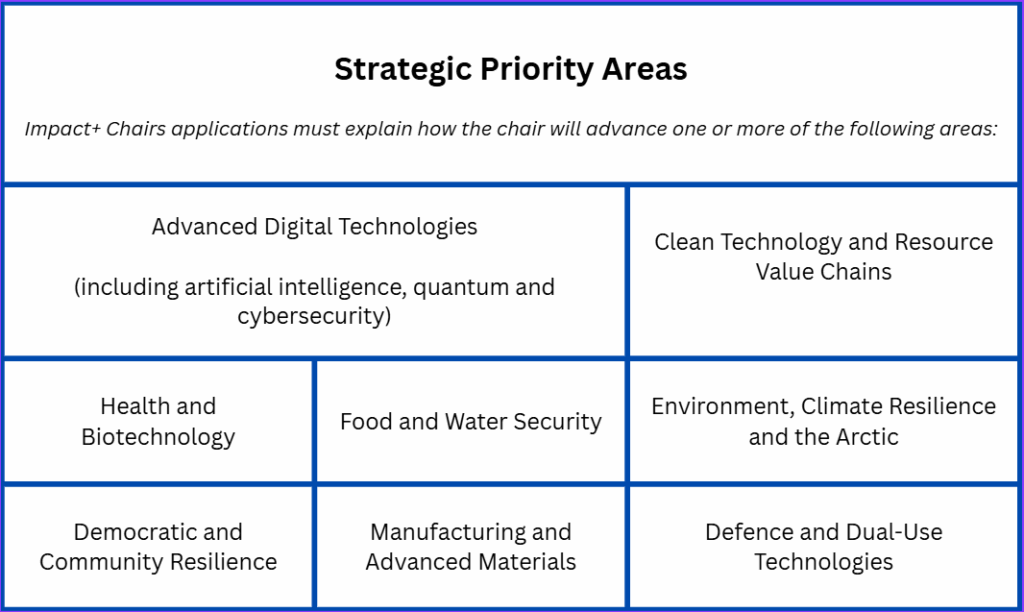
Of the $1 billion, the Natural Sciences and Engineering Research Council (NSERC) will grant the largest share, up to $530 million, while $340 million will be granted by the Canadian Institutes of Health Research and $198.5 million by the Social Sciences and Humanities Research Council.
University leaders are roundly applauding the program’s launch. Gabriel Miller, president and CEO of Universities Canada (publisher of University Affairs), wrote that “Canada’s universities are ready to work with the federal government to turn these commitments into long-term impact for communities nationwide.”
Robert Asselin, chief executive officer of U15, an association of Canada’s leading research universities, celebrated the announcement and called on prospective researchers.
“To international researchers considering whether to come to Canada to build their careers and advance their ideas, our message is clear: Canada is a supportive and welcoming destination, with world-class research universities to partner with your work,” he stated in a press release, adding, “Our universities remain steadfast in defending academic freedom, advancing scientific excellence and investing in the success of Canada’s research community.”
Application deadlines next spring
Eighty-two universities will be eligible to recruit Impact+ chairholders and will be expected to support their research endeavors throughout their time in Canada. Degree-granting universities must have previously received an annual average of $100,000 or more from the Tri-Agencies to qualify.
Universities can apply for any combination of $500,000 or $1 million per year award values up to a yearly, institution-specific dollar limit determined by the government. Canada’s largest universities were allocated the highest ceilings, with the University of Toronto capped at $35 million and the University of British Columbia and McGill University at $25 million each. The bulk of universities were limited to either $3 million (32 institutions) or $2 million (23 institutions).
Universities must make their Impact+ Research Chairs applications by March 2026 for the first intake and June 2026 for the second intake.
Targeting early-career researchers, PhD students and post-docs
A complementary initiative is aimed at early-career researchers (ECRs). Canada Impact+ Emerging Leaders is a $120 million fund over 12 years to bring more internationally based ECRs to Canada. Universities that are nominating an Impact+ Research Chair can request an additional $100,000 per year over six years to recruit an ECR.
The ECR must be working in the same strategic priority area as the Impact+ Research Chair but doesn’t necessarily need to be in the same research field or discipline. Emerging Leaders will be eligible for a six-year extension, at the same amount, if their research “has been transformational, translational and has garnered partners,” and they’ve made progress in their academic careers.
The suite of funding also includes $133.6 million over three years to help top international doctoral students and post-doctoral researchers relocate to Canada. The Canada Impact+ Research Training Awards will provide 600 doctoral scholarships valued at $40,000 per year and 400 postdoctoral research awards at $70,000 per year to international talent working in the government’s priority research areas.

Fahim Quadir, vice-provost and dean of graduate studies and postdoctoral affairs at Queen’s University, said the new Impact+ Research Training Awards represent an important step towards strengthening Canada’s talent pipeline. “This initiative positions us more competitively in the global search for the next generation of researchers, innovators and leaders,” said Dr. Quadir, who is also president of the Canadian Association for Graduate Studies.
“I see this to be Canada’s long overdue commitment to talent development, which is central to Canada’s sovereignty, competitiveness and global leadership.”
Universities will be given a set number of Impact+ Research Training Awards and can distribute them to researchers holding an active grant from one of the three funding agencies. Successful researchers can then nominate and recruit candidates, including Canadian citizens, currently abroad. Universities will then submit an application on behalf of the nominator to the appropriate Tri-Agency who will then review the candidate’s eligibility. More information about the process will be shared directly with universities in the coming weeks, according to an NSERC press release.
The Impact+ Research Training Awards program is designed for “rapid delivery.” The first nominations must be submitted in early 2026 and a second phase will begin in April 2026.
Infrastructure funding to support new chairs
In addition to the award announcements, the government will be providing funding to universities through the Canada Foundation for Innovation for research-enabling infrastructure.
The Canada Impact+ Research Infrastructure Fund will provide $400 million over six years to support the work of newly recruited research chairs, and, where applicable, early career researchers. The funding will cover both capital costs and operating and maintenance costs, with totals varying depending on the needs of the chairholders. The maximum award value is $6 million.



Featured Jobs
- Theatre and Film - Assistant Professor Without Review (Performance Practice)The University of British Columbia
- Psychology - Assistant Professor (Clinical Psychology)Western University
- Global Inequalities and Trade - Faculty PositionUniversité Laval
- Director, Human Research Ethics & Strategic AdvisorUniversity of Manitoba
- International Studies - Faculty Position (Arctic Defence and Security)Université Laval
More from News
-

Parliamentary committee urges stronger support for research in French
Granting agencies should consider funding targets specifically for French-language projects, the Standing Committee on Science and Research recommends.
-

Remove EDI from research funding decisions, parliamentary committee says
The Standing Committee on Science and Research says ‘discriminatory’ EDI policies are ‘weakening the quality of Canadian research’.
-

Good medicine: new programs train country doctors
Université de Montreal follows Queen’s prescription to heal the shortage of family physicians in rural areas.
-

Quebec’s English-language universities embrace new French requirements as fall cohort begins
McGill, Concordia and Bishop’s universities roll out new initiatives to encourage students to learn French on and off campus.
More from Research funding
-

Writing a successful narrative CV
A guide and template to help you ace the upcoming Tri-Agency curriculum vitae.
-

Answering the “So what?” in SSHRC applications
How to articulate the expected scholarly outcomes of your proposed research project.
-

Narrative CVs put researchers front and centre
New format is a vast improvement over the old Canadian Common CV.
-

How to win the Rhodes Scholarship
A Concordia University graduate shares his tips for scoring a full ride to Oxford University.
More from Articles
-

Universities struggle to be heard in Quebec election
In a campaign dominated by the U.S. trade war and the soaring cost of living, universities assert their continued importance.
-
Attacks on higher education spread globally, including in liberal democracies, Scholars at Risk report finds
Canada urged to defend values amid erosion of institutional autonomy in the U.S.
-

Grad student visas double since 2025
Policy changes drive sharp rise in permits for international master’s and PhD candidates.
-

Where do Quebec’s political parties stand on higher education?
With the provincial election less than a month away, we provide a roundup of platforms and promises.


Post a comment
University Affairs moderates all comments according to the following guidelines. If approved, comments generally appear within one business day. We may republish particularly insightful remarks in our print edition or elsewhere.
4 Comments
Is there any possibility to get admission in PhD with material Science (Physics) within Canada through this scholarship?
Does anyone know the answer to these questions?
1. There are specific buckets of money for NSERC, medical, and SSHRC disciplines. But some schools, e.g. Guelph, appear to be explicitly advertising only NSERC opportunities. Is there any mechanism internal to the scheme management to ensure a strong nomination pool for each of the three funding buckets, or is the idea just that we hope things work out, e.g., Guelph is explicitly going for only NSERC folks, but other schools will favour medical or SSHRC folks, and it will all even out in the end?
2. It’s unclear whether different universities can nominate the same person. E.g. if someone applies to Alberta and Dalhousie, can both universities nominate them? If so, what is the procedure for giving the award? Would the top-level committee that approves nominations say “we give it to university A, not university B’, or would it be more like “either A or B can have this person”? For the sake of the question I am assuming the person is strong enough that, had they applied to and been nominated by only one university, they would be given the award, regardless of which university they had applied for.
Well, I found the answer to the 2nd question. A person can only be nominated by one institution. This makes sense for the normal Canada Research Chair competition, where each institution has a set number of chairs available, but it is difficult to see why it makes sense for the Impact+ scheme, given that it is competitive even after being nominated. If universities A, B and C all say they would love to nominate a candidate, that person has to choose, from a position of almost complete ignorance, what their chances are of success in the competition if they’re nominated by A vs B vs C.
Moreover, designing the process this way virtually guarantees subpar outcomes, for candidates, for universities, and for the goals of the scheme. Do our funding bodies not have the brainpower to game this out and see why this is true?
It would be refreshing to see Canada invest in Canadian talent, to give more young Canadians the opportunity to even dream of becoming “top-tier”. Seriously, there are so many barriers to accessing the training necessary to achieve excellence in Canada. Could we please invest in Canadians for once?