Universities setting sights on India for transnational education opportunities
A number of Canadian universities signed MOUs with Indian post-secondary institutions.
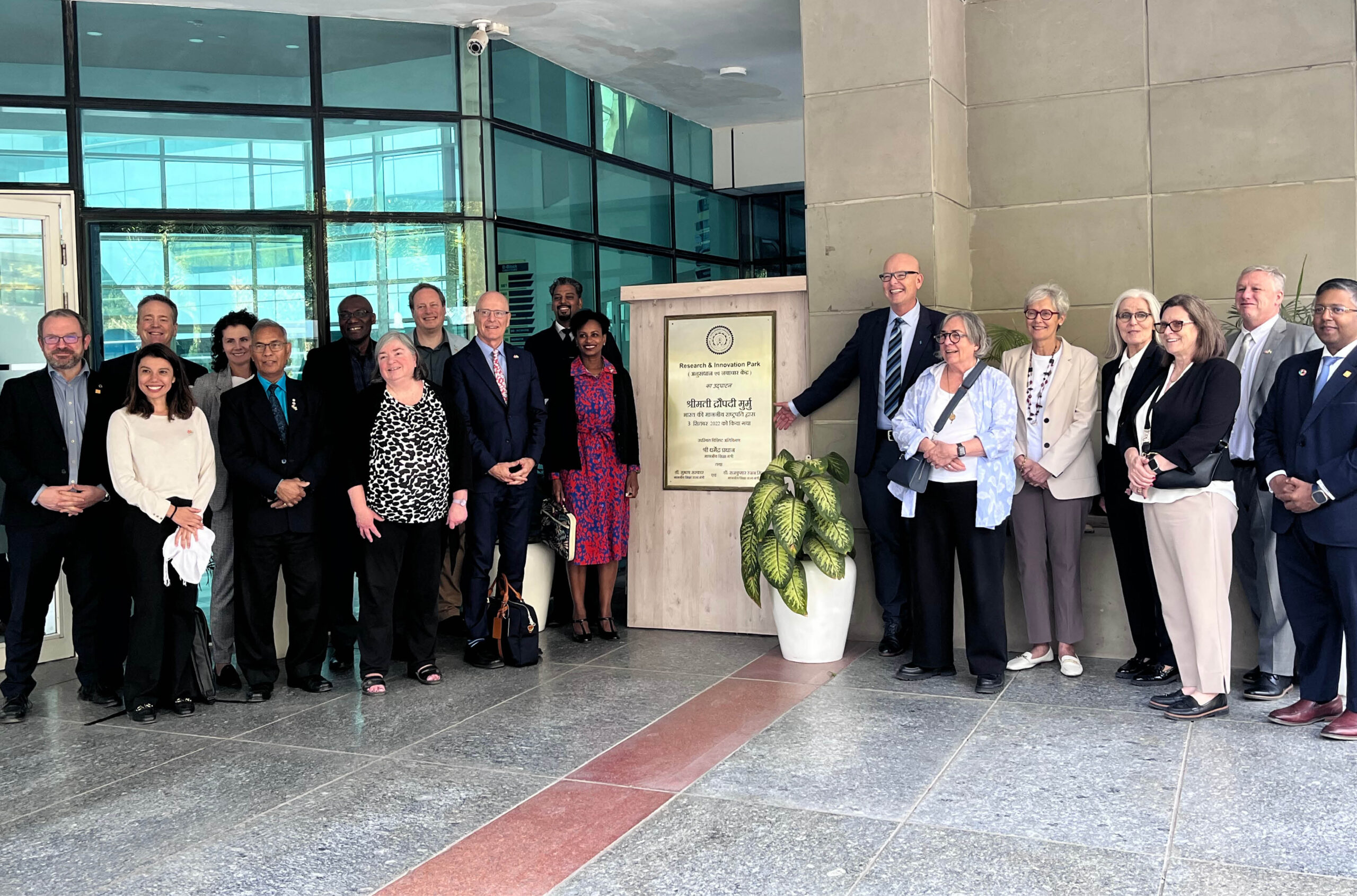
Canadian academic leaders travelled to India as part of a delegation aimed at strengthening economic and academic ties between the two countries.
Twenty-one university presidents joined the delegation, led by Universities Canada, that met with Indian government officials along with university and private sector leaders.
More than a dozen Memorandums of Understanding (MOUs) for transnational educational opportunities were signed between Canadian universities and Indian post-secondary institutions.
The five-day trip was the first in a series of Canadian engagements with India which will culminate with a visit by Prime Minister Mark Carney in early March.
Gabriel Miller, president of Universities Canada (University Affairs’ publisher), described the mission as positioning universities as central to Canada’s broader efforts to realign its global economic relationships.
“It’s important to recognize that this mission is happening at an extraordinary moment for us and it puts universities at the centre of the national effort to reengineer our economy and reinvent our place on the world stage,” he said.
While India is Canada’s largest source of international students, the visit did not focus on recruitment. Rather, the delegation sought to rebuild trust, deepen institutional relationships and expand industry partnerships, with a near-term goal of advancing research collaborations between the two countries.
Relations with India deteriorated sharply in 2023 after Canadian intelligence revealed that Indian state agents were linked to the killing of Canadian Sikh activist Hardeep Singh Najar in British Columbia. Both countries expelled diplomats and India temporarily suspended visa processing for Canadians, while Canada closed three of its consulates, limiting its services to New Delhi.
Then, in 2024, Ottawa introduced a cap on international student visa permits, reducing inbound student mobility from India while diminishing Canada’s viability as a study destination.
Now, as Canada seeks to diversify away from its economic dependence on the United States in light of U.S. president Donald Trump’s trade war, there is renewed momentum in Canada-India relations. At the same time, India is turning westward to broaden its trade partnerships – having finalized a landmark free trade agreement with the European Union at the end of January. For Canada, the agreement could serve as a model as it advances trade negotiations with New Delhi. Universities, for their part, want to position themselves as essential to both economies.
“Renewed diplomatic engagement and complementary economic priorities make this an opportune moment to deepen collaboration,” said Rhonda McEwen, president of Victoria University in the University of Toronto.
The mission not only helped “lay the groundwork to deepen the broader trade relationship between Canada and India,” said Larissa Bezo, president and CEO of the Canadian Bureau for International Education, but to correct the misperception that educational ties between the two countries is limited to inbound student mobility from India into Canada. “Missions of this kind demonstrate the breadth, depth and long-standing nature of the relationship,” she added.

The mission also comes on the heels of Ottawa’s investment of $1.7 billion in funding for a comprehensive talent attraction program to bring international researchers to Canadian institutions. Five leaders from Canada’s top 15 research universities comprised the delegation.
Presidents met with leaders from India’s higher education sector and government representatives in Goa, New Delhi and Gujarat International Finance Tec-City, or GIFT City, a financial and business hub touted as India’s first “smart city.”
Transnational education and branch campuses
India’s Ministry of Education projects that 13 to 14 million high school graduates are expected to seek post-secondary opportunities in the coming years, creating substantial demand for high-quality education at home and abroad.
The visit sought to advance partnerships to benefit faculty, staff and current and future students in both countries. More than a dozen MOUs were signed by Canadian universities and Indian post-secondary institutions.
The University of Windsor and Anant National University’s Anant School for Climate Action signed an MOU that will facilitate joint research initiatives, student exchanges and graduate pathways over the next five years with a focus on sustainability. The agreement also provides a framework for future short-term immersion programs.
And the University of the Fraser Valley and Panjab University signed an MOU to establish a bachelor of business administration dual degree program where eligible students will receive degrees from both institutions.
Collaborations also include “two-plus-twos,” where students complete two years of study in their home country and two years overseas, Indian students accessing Canadian curricula, distance learning opportunities, student exchanges and, notably, satellite campuses.
Since 2020, India has introduced several regulatory reforms to make the country more attractive to foreign universities, as part of a wider strategy to internationalize its higher education landscape.
Its “Setting Up and Operation of Campuses of Foreign Higher Educational Institutions in India Regulations, 2023” created a dedicated path for stand-alone foreign campuses. The policy allows for degree equivalencies in both countries and grants significant autonomy to foreign institutions for governance, curricula and admissions.
Foreign universities, for their part, must be ranked in the top 500 in the QS World University Rankings and ensure the academic quality matches what is offered at their home campuses.
The incentive appears to be working. Three foreign universities have already established campuses in India and five more will open campuses in 2026 and 2027, including the Illinois Institute of Technology and the University of Liverpool.
GIFT City is particularly appealing to foreign universities due its status as a special economic zone.
The financial hub provides a substantive tax holiday – 10 years within the first 15 years of operations are tax-free – and specified capital gains tax exemptions. Further, it grants universities full repatriation of profits, tax neutrality on cross-border flows, and free foreign currency conversion– all of which make it fiscally attractive for foreign post-secondary institutions.
“Our view is that the best way to approach those partnerships is with co-created platforms built with Indian institutions,” added Dr. Brooks.
Industry partnerships
Canadian universities are well positioned to contribute knowledge and talent to priority areas for both countries such as critical minerals, energy, agriculture – and artificial intelligence in particular.
The transformative technology provides an opportunity for partnership between the two countries given the depth of Canadian expertise and India’s ability to quickly mobilize talent and commercialize technology – something Canada has long struggled to achieve.
“In AI, Canada’s strengths in responsible AI and privacy-by-design complement India’s scale, engineering talent and dynamic technology sector,” said Dr. McEwen.
The timing is also symbolically and strategically important because India is hosting a global AI Impact Summit in the coming weeks, and a strong Canadian delegation – including the Minster of Artificial Intelligence and Digital Innovation, Evan Solomon – is expected to attend. “High-level engagement signals that AI collaboration is central to economic competitiveness in both countries,” added Dr. McEwen.
While in New Delhi, the delegation took part in an industry roundtable with the Federation of Indian Chambers of Commerce and Industry, the country’s largest business advocacy association, to explore new partnership models for India’s national priorities in skills development, innovation, entrepreneurship and applied research.
“If Canada is serious about diversifying and strengthening its innovation economy, building industry-connected partnerships in India isn’t optional, it’s essential and strategic,” said Kim Brooks, president and vice-chancellor of Dalhousie University.



Featured Jobs
- Canada Impact+ Research ChairInstitut national de la recherche scientifique (INRS)
- Health Sciences - Assistant ProfessorSimon Fraser University
- Vice President, Finance & AdministrationOCAD University
- Marketing - Faculty Position, Tenured or Tenure TrackUniversity of Alberta
More from News
-

Addressing academia’s pretendian problem
Two Indigenous professors create a reference guide to stop scholars who falsely claim Indigenous heritage.
-
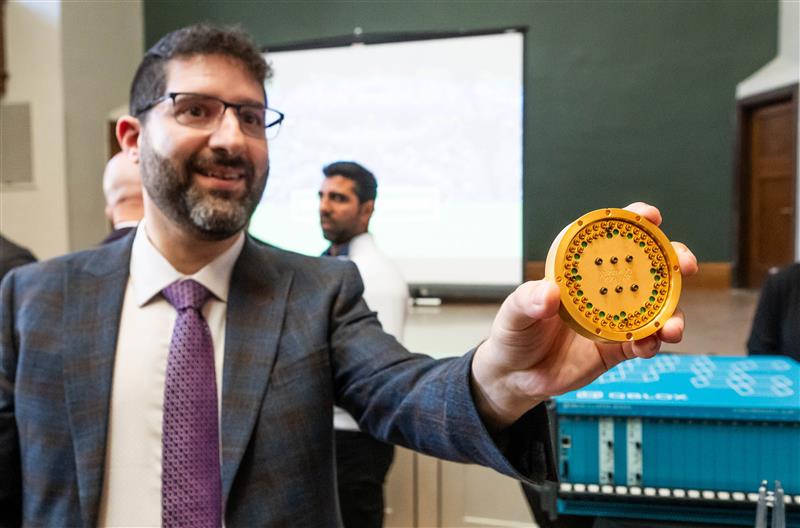
University of Saskatchewan acquires quantum computer to boost research capacity
Campus access to the technology will expand research possibilities.
-

McGill appoints French emissary, makes peace with province
After dropping its legal battle over out-of-province tuition hikes, the university increases its efforts to promote French language and culture.
-
Ontario budget reaffirms $6.4 B post-secondary funding boost, adds money for infrastructure
Millions more allocated to research, clinical nursing training, and French-language education.
More from Universities Canada
-

Canadians need universities — and so will their next government
Higher education is the missing piece in Canada’s economic strategy.
-

Heading home
The outgoing president and CEO of Universities Canada reflects on the past 14 years.
-

New reports offer an update on the tasks ahead for Laurentian University
Details shed light regarding the ongoing situation at the bilingual university in northern Ontario.
-

What do universities owe Canadians?
The higher education community must act as a guiding light as we return to more in-person activities.
More from Articles
-

Manitoba increases investment in post-secondary education, announces new commission in 2026 budget
Post-secondary institutions will receive $882.6 million in operating funding.
-

Program changes at Memorial raise concerns
Impact on faculty and students remains unclear amid decreased enrolment and financial challenges.
-

UBC leads the way on civil discourse
A successful debate series places universities at centre stage in ending polarization.
-
Quebec makes 5-year, $392M investment in universities to drive economic growth
With targeted investments in research and innovation, the provincial budget banks on universities to boost the economy — but fails to address structural underfunding.


Post a comment
University Affairs moderates all comments according to the following guidelines. If approved, comments generally appear within one business day. We may republish particularly insightful remarks in our print edition or elsewhere.