Grad start-ups tackle pollution
Canadian university teams competing for the prestigious Hult Prize have gone on to found companies that create plastic from seaweed and purify water with quantum chemistry.

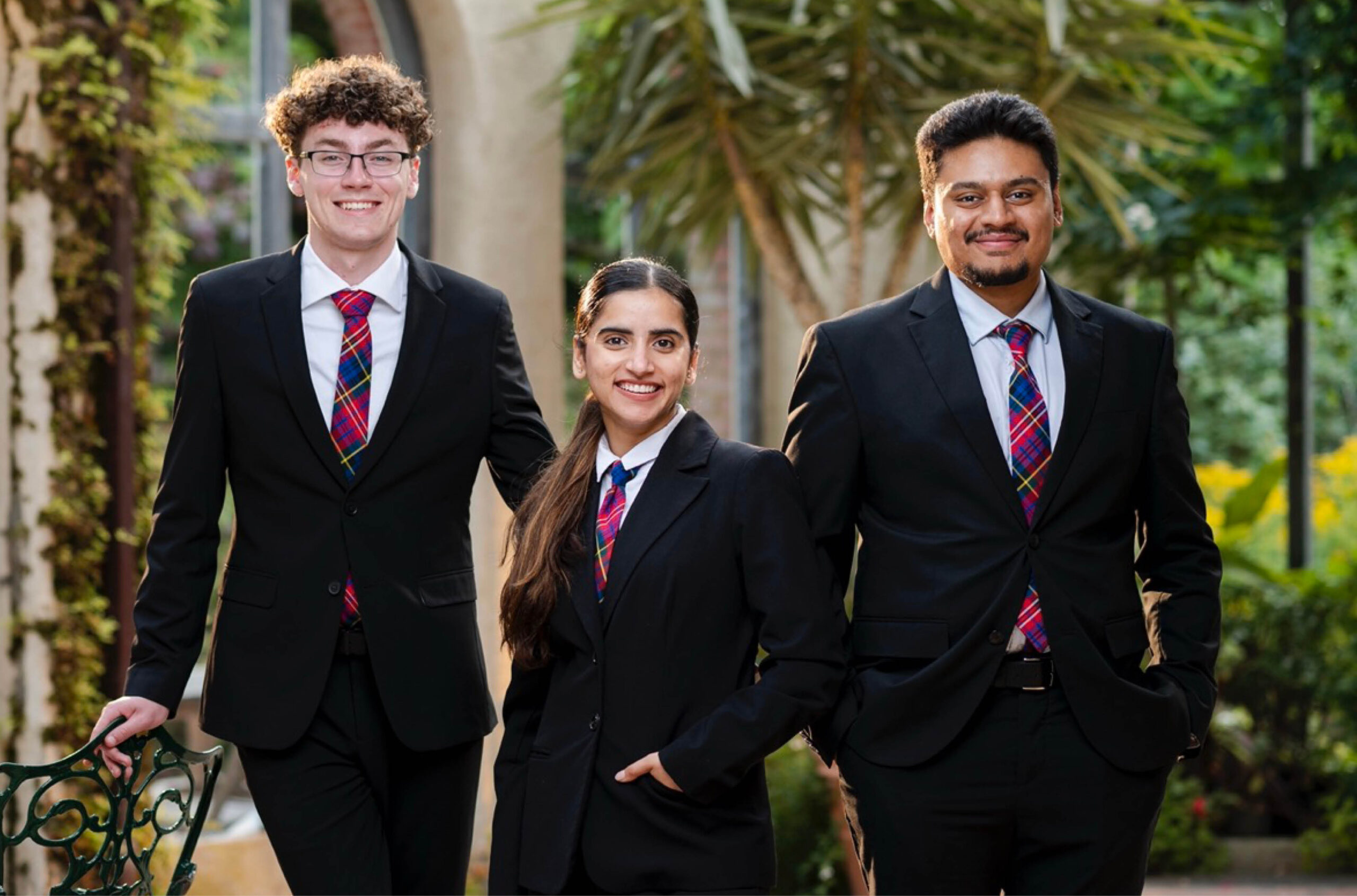
Recent Saint Mary’s University graduate Sheheryar Khan had a busy 2025. Alongside his academic work and valedictorian duties, the young scientist from Dubai launched a Halifax startup company that can convert seaweed into biodegradable plastic packaging for the food industry.
On the advice of a mentor at Saint Mary’s Arthur L. Irving Entrepreneurship Centre, Mr. Khan, who graduated with a B.Sc., Diploma in Engineering, used his undergraduate laboratory research to launch his own environmental packaging company, Alaagi, in late 2024. He spent 2025 refining his seaweed process and entering pitch competitions in search of startup funding.
Mr. Khan’s early presentations were less than successful — his shy demeanour and rapid-fire speech in heavily accented English created some communication difficulties. At one session, the audience thought he was producing macaroni in plastic bags when he was really showing off a prototype poly bag that was filled with a food sample.
But Mr. Khan’s persistence paid off when he entered the early round of the international Hult Prize — a Dragon’s Den-style competition that annually pays out US $1 million to a student-owned company focused on social entrepreneurship. After winning the Canadian title last spring, Khan and his small Saint Mary’s team earned a slot in the semifinal international round of the Hult Prize’s Global Accelerator program. The trio, Tyler MacLean, Vaishali Sachdeva, and Mr. Khan, travelled to England in August with 27 other international student teams for a month-long entrepreneurial bootcamp and retreat at stately Ashridge House, a 200-year-old estate northwest of London that is home to the Hult International Business School’s executive program. (Its 5,000-acre grounds were also the location for many scenes in the Harry Potter movies.)
Summer accelerator program leads to business opportunities
Since 2010, the Hult organization has used its prize program to inspire student entrepreneurs to tackle global issues through their own for-profit companies. Hult’s key areas of interest include education, water supply, food security, job creation and resource-wasting industries such as fashion.
Working with a coterie of international entrepreneurs, consultants, Hult resource staffers and dozens of their fellow competitors, each summer’s two dozen accelerator teams have four weeks to fine-tune their business plans and funding pitches in preparation for the final elimination round. In the end, only eight teams face off for the million-dollar prize. Each finalist has four minutes to convince a small panel of judges that its project aligns with the organization’s sustainable development goals and has the personnel and business road map to succeed. Essentially, they must explain the social value of their company and how the Hult seed money will lift them to the next level. The competition reboots each September after the announcement of the latest winner.
In London this fall, Mr. Khan’s Alaagi seaweed technology project failed to reach the final round of the competition, which was ultimately won by two students from Singapore pitching their Stick Ems’ STEAM education startup.
But the experience gave Mr. Khan the confidence to pursue funding, customers and a search for a few employees back home. To date he has signed letters of intent with companies that could generate $12 million of business, and established pilot projects at Sobeys and High Liner Foods. And he ultimately claimed another international prize before year’s end.
In October, Alaagi teamed up with Saint Mary’s Square Roots startup to win the 2025 Enactus World Cup in Thailand for the university. Enactus is a worldwide non-profit that helps students develop leadership and social entrepreneurship skills.
Alaagi was also accepted into Dalhousie University’s Emera ideaBUILD program, a 10-month program that offers founders a $10,000 grant towards prototyping materials, a 12-week bootcamp, and industry advisers who work alongside them to validate and build their product’s first operational prototype.
Hult keen to expand its reach in Canada
Kate Ramirez, Hult Prize’s regional manager for North America, told University Affairs she is keen “to expand our reach in Canada quite a bit… There were 14 Canadian campuses involved in 2024.” While some participating universities have established Hult Prize clubs to organize competitions, newcomers often depend on a sole professor (usually in a business school) or even a student co-ordinator to work with Ms. Ramirez to launch the first level of university competition.
The Alaagi team aren’t the first Canadians to benefit from the Hult Prize competition.
In 2024, University of Toronto’s Xatoms was one of the six Hult Prize finalists to spotlight their work. Applying the principles of quantum physics, Xatoms uses photocatalysts that react with light to clean badly polluted water.
Long before entering the Hult Prize competition, Xatoms CEO Diana Virgovicova, a Slovakian native, had her innovative work recognized internationally. At age 17, she won the Stockholm Junior Water Prize for her initial work with photocatalysts, after showing that her method could break down organic pollutants like bacteria, pesticides and herbicides. Later, a Lester B. Pearson Scholarship brought her to Canada, where she now works with colleagues Kerem Ismail Oglou, Chief Technology Officer, and Chief Operating Officer Shirley Zhong in a Mississauga, Ont., laboratory.
While Xatoms’ four-minute pitch did not ultimately win Hult’s million-dollar prize, the accelerator experience helped connect them to more investors and potential customers. Currently, they have attracted investments of $3 million that will help fund commercialization of their research, have applied for eight patents and established three water-cleaning pilot projects in Texas, South Africa and Kenya. Hult Founder, Bertil Hult, a Swedish billionaire who made his fortune through innovative language and educational schools, outlined his philosophy this year on the 15th anniversary of the Prize. “Social entrepreneurship is something different,” he explained on an Instagram video. “The idea is to bring something good to the world, to help people… It’s not just to make money. It’s to make our world a better place.”



Featured Jobs
- Theatre and Film - Assistant Professor Without Review (Performance Practice)The University of British Columbia
- Global Inequalities and Trade - Faculty PositionUniversité Laval
- Psychology - Assistant Professor (Clinical Psychology)Western University
- Movember Institute Discovery Research Program FellowshipsThe University of British Columbia
- Toldo Chair in Christian StudiesAssumption University
More from News
-

Ottawa won’t restrict student visas from countries with high asylum-claim rates
India will help Canada ‘crack down’ on student program abuses, high commissioner says.
-

Students and seniors under the same roof
Intergenerational living helps with loneliness and the high cost of rent.
-

U Sports alum lace up for PWHL season
Canadian grads eager to show their mettle on women’s pro hockey teams.
-

The hidden problem of student homelessness
As high rents push more students into precarious housing, it's time to stop romanticizing the 'poor scholar'.
More from Research
-

How serendipity built a cross-disciplinary career
Taking research positions out of economic necessity allowed me to gather a broad set of skills and knowledge.
-

Science in French? Bien sûr!
As English dominates the publication landscape, support for French-language research is a strategic investment in the quality, equity and the future of knowledge.
-

From doctoral student to entrepreneur
Resources abound to help you turn your PhD research into a business startup.
-
Ottawa announces 64 new research chairs in international talent attraction strategy
Top-tier researchers from 13 countries to join Canadian universities in first wave of appointments.


Post a comment
University Affairs moderates all comments according to the following guidelines. If approved, comments generally appear within one business day. We may republish particularly insightful remarks in our print edition or elsewhere.