UNB educates Indian nurses to bolster province’s health care
Partnership with Manipal Academy of Higher Education brings Canadian component to international nursing education.

In its search for solutions to the country’s shortage of nurses, Canada annually admits thousands of foreign-educated nurses anxious to work in its health-care system. But the reality of provincial nursing regulations prevents the newcomers from easily joining the more than 300,000 registered nurses (RNs) in Canada.
To qualify for nursing jobs in Canada, the “internationally educated nurses” (IENs) typically spend years and thousands of dollars upgrading their language and clinical skills in preparation for strict provincial licensing examinations. Despite those challenges, more than 53,000 IENs — about 15 per cent of Canadian working RNs — have successfully navigated the system, and the number is growing. According to the Ontario College of Nurses, more than half of the new RN licences in that province went to IENs.
But many others abandon their nursing dreams to take lower paid, more easily accessible jobs such as personal care workers and cleaners, something that rankles Dr. Lorna Butler, dean of nursing at the University of New Brunswick (UNB).
“The ‘de-skilling’ of their registered nursing licensure is problematic for me,” she says. “And at the same time there is a concern raised by the International Council of Nurses that wealthy countries are stripping Third World countries of their senior nurses, leaving their organizations potentially devastated.”
(A 2025 International Council of Nurses report complains that Canada annually avoids more than $1 billion in training costs by recruiting nurses from low- and middle-income countries like the Philippines, India and Nigeria.)
Dual program seeks to ethically recruit international nurses
To begin addressing the problem, Dr. Butler and the faculty of nursing and health sciences launched a dual nursing program in 2022 that incorporates Canadian nursing standards into a four-year nursing program at the Manipal Academy of Higher Education (MAHE), a leading university in India. After graduation, the students from India are eligible to take the New Brunswick nursing college exam in India so, theoretically, they can step off a plane in Fredericton with a job offer in hand.
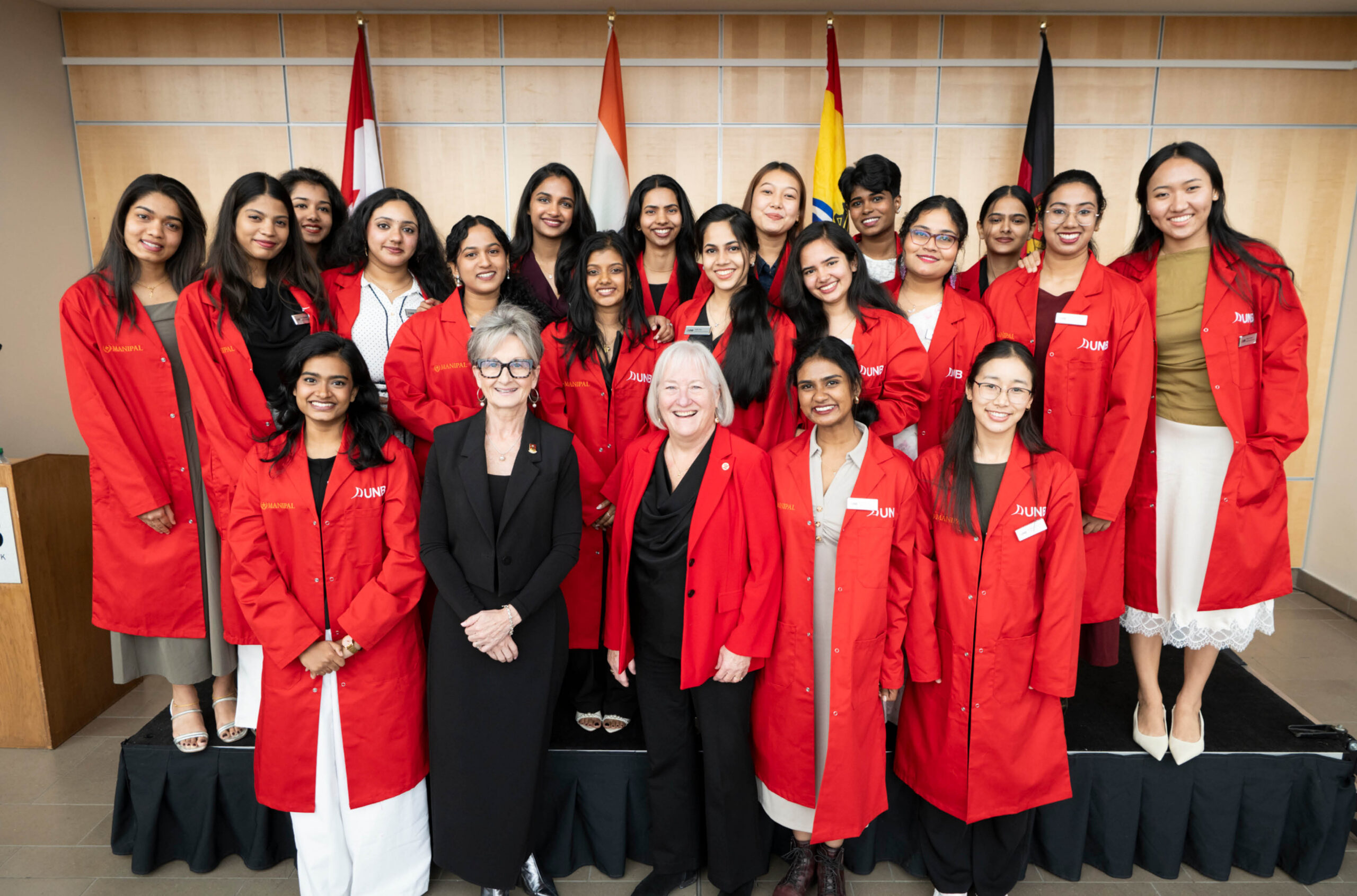
“We will make sure students succeed,” says Dr. Butler, who currently has 99 students registered in the four-year dual program being taught in Udupi, in southwestern India. Twenty-five new students will start this fall, just as the first cohort of 25 students graduates.
Building the program was no easy feat. The UNB team studied the MAHE curriculum line-by-line to determine what was missing and then developed specific modules to meet Canadian standards, including social justice and clinical decision making. The university also brought two small groups of students from India to Fredericton for summer institutes to assess their reaction to UNB’s nursing program and local medical facilities.
From the outset, Dr. Butler and her team involved multiple levels of government (including Immigration, Refugees and Citizenship Canada), medical regulators and Fredericton’s hospital network and nursing homes, where students would spend their internships (and find future employment).
“We’ve made sure that anyone that would have influence or could support the movement of the students to and from Canada are engaged,” Dr. Butler says. “Because if there’s not a seamless transition when nurses finish this degree and get to Canada, then that’s a [reputational] issue for Canada.”
At the start of the program, several of the Canadian stakeholders accompanied her to India. New Brunswick nursing regulators met their Indian counterparts; UNB’s registrar visited the MAHE campus, along with executives from Fredericton’s Horizon Health Network and Shannex nursing homes.
“I felt that if they didn’t see for themselves what Manipal had to offer it would be very difficult for us to explain or represent them properly. We didn’t want any assumptions or any preconceived ideas from television or social media. We wanted them to go and experience it themselves. And I really think that made a difference.”
Meanwhile, MAHE had to win permission from India’s nursing council to grant extra seats to its student quota, so the Canadian course didn’t reduce the number of domestic RN graduates.
“Manipal still has its 100 seats a year… so they (will) graduate the same number that they always did,” says Dr. Butler.
A path to immigration
Currently, UNB faculty members teach classes virtually alongside Manipal professors in first and third years, along with a month of personal teaching at MAHE at the end of year three. In spring of year four, the students have the option to perform a six-week preceptorship in Fredericton with Horizon Healthcare Network and local Shannex nursing homes. Nineteen students made the journey this year, many travelling outside of India for the first time.
Their first taste of New Brunswick is important for Dr. Butler. “Being here for the preceptorship is not just about nursing,” she says. “It’s also whether or not they feel that this is a community where there they will be welcomed, whether it is safe to bring their families, whether they are valued.”
Dr. Butler expects that most of the dual graduates will immigrate to Canada. Starting this fall, UNB will offer licensure preparation classes and immigration assistance for graduates planning to work in New Brunswick.
MAHE student Della Raju was impressed and told CBC news, “If I get a job opportunity here, I’ll be coming back.”
While the first group of MAHE students commented on the favourable working conditions, the UNB faculty members were impressed by their six-day-a-week work ethic.
“We found that the students were so intense and they just wanted to learn everything,” observes Dr. Butler. “We were exhausted by the end of the day.”
While the dual nursing program is small by national standards, it has potential to expand well beyond UNB. “This model would be transferrable to any other organization or nursing program that wanted to do this,” says Dr. Butler.



Featured Jobs
- KAUST Global Fellowship Program - Postdoctoral Fellowship (Call 2027)King Abdullah University of Science and Technology
- Global Inequalities and Trade - Faculty PositionUniversité Laval
- Director, Human Research Ethics & Strategic AdvisorUniversity of Manitoba
- International Studies - Faculty Position (Arctic Defence and Security)Université Laval
- Theatre and Film - Assistant Professor Without Review (Performance Practice)The University of British Columbia
More from News
-

U Sports alum lace up for PWHL season
Canadian grads eager to show their mettle on women’s pro hockey teams.
-

The hidden problem of student homelessness
As high rents push more students into precarious housing, it's time to stop romanticizing the 'poor scholar'.
-

Parliamentary committee urges stronger support for research in French
Granting agencies should consider funding targets specifically for French-language projects, the Standing Committee on Science and Research recommends.
-

Remove EDI from research funding decisions, parliamentary committee says
The Standing Committee on Science and Research says ‘discriminatory’ EDI policies are ‘weakening the quality of Canadian research’.
More from Teaching
-

Good medicine: new programs train country doctors
Université de Montreal follows Queen’s prescription to heal the shortage of family physicians in rural areas.
-

Level Up Learning
Amélie Vallières investigates how story-driven video games can support learning and build identity.
-

Aligning curricula with the workforce: the case against
Mazen Guirguis argues that the university should return to its Socratic roots.
-

Aligning curricula with the workforce: the case in favour
Matthew McKean and Valerie Walker argue that students aren't choosing between learning and work, so why should universities?
More from Articles
-

Universities struggle to be heard in Quebec election
In a campaign dominated by the U.S. trade war and the soaring cost of living, universities assert their continued importance.
-

Quebec’s English-language universities embrace new French requirements as fall cohort begins
McGill, Concordia and Bishop’s universities roll out new initiatives to encourage students to learn French on and off campus.
-

Attacks on higher education spread globally, including in liberal democracies, Scholars at Risk report finds
Canada urged to defend values amid erosion of institutional autonomy in the U.S.
-

Grad student visas double since 2025
Policy changes drive sharp rise in permits for international master’s and PhD candidates.

Post a comment
University Affairs moderates all comments according to the following guidelines. If approved, comments generally appear within one business day. We may republish particularly insightful remarks in our print edition or elsewhere.