B.C. budget announces little help for universities
Post-secondary sector receives small funding increase amid widespread public sector cuts.
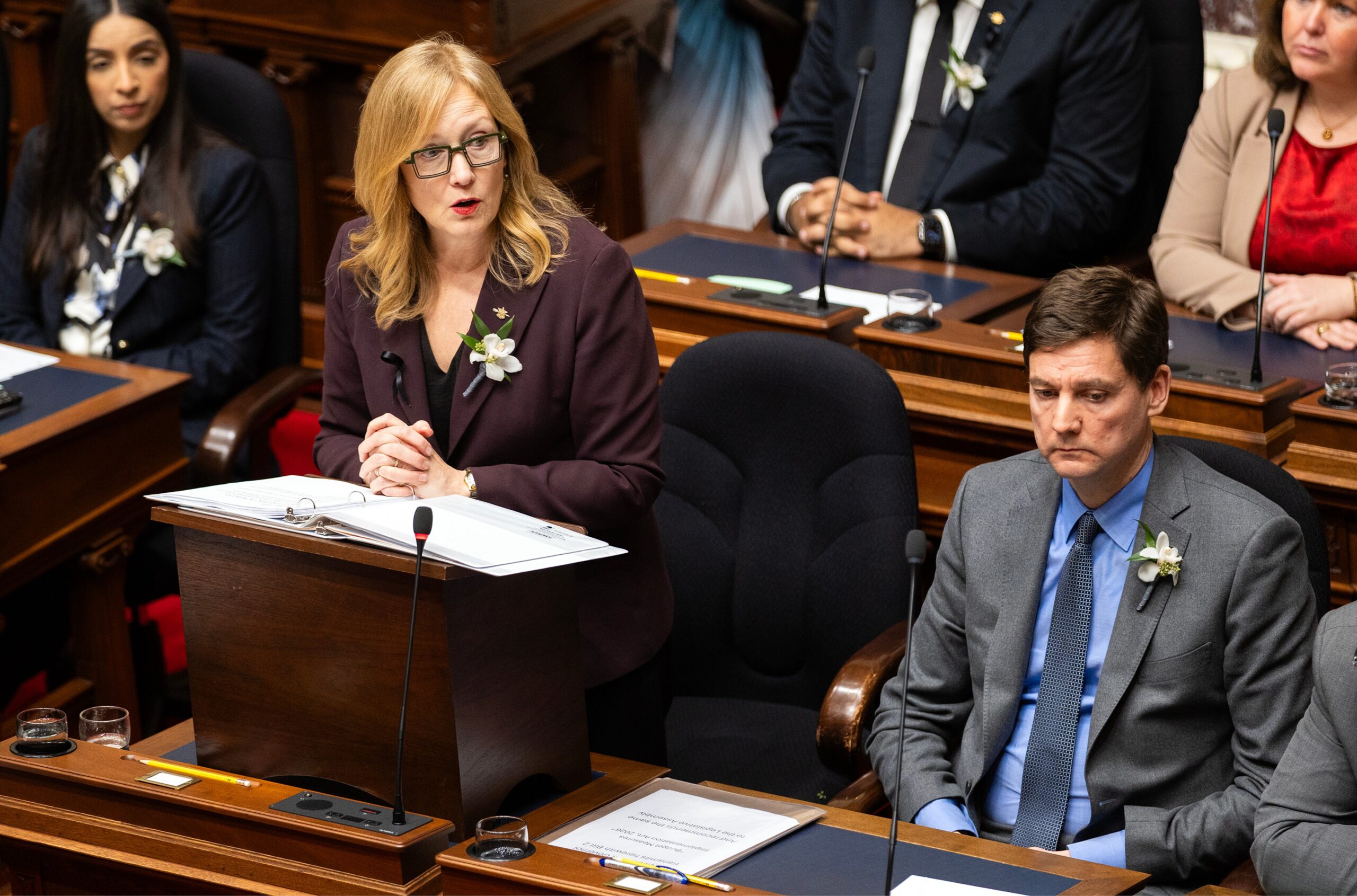
Post-secondary institutions in British Columbia will be bracing for more financial strain in the years ahead, with only a modest increase to their base funding in the provincial budget tabled by Finance Minister Brenda Bailey Tuesday.
The province’s 25 public post-secondary institutions — including six research universities, five teaching universities, 11 colleges and three institutions — will receive an increase of $394 million in annual funding over the next three years, from $9.1 billion in 2025-26 to $9.5 billion by 2028-29. The budget notes that the “modest increase” is driven by general inflation impacting operating costs and ongoing infrastructure projects including student housing and the new medical school at Simon Fraser University (SFU).
The budget also included supplementary funding for training in skilled trades and certain in-demand STEM fields. The post-secondary measures were part of a slim budget focussed on helping the province recover from a projected $13.3 billion deficit for fiscal year 2026-27.
The minister said that the province is in a “period of fiscal pressure” and that the budget, which includes tax increases and public sector job cuts that could impact universities, is aimed at financial sustainability and protecting the core services of health and education.
The fiscal year of 2025-26 is the first one in which British Columbia’s post-secondary sector is forecasting a consolidated deficit — with 19 of the province’s 25 post-secondary institutions projecting at least one annual deficit in the next three years.
University deficits will only intensify from provincial under-investment, said Annabree Fairweather, executive director of the Confederation of University Faculty Associations of British Columbia. She said this will lead toreduced access to education for students, particularly those from regional communities.
“Students will have less choice, less educational access, and in the end, it doesn’t help the government meet their economic development and workforce needs,” said Ms. Fairweather.
SFU is among the post-secondary institutions that are still operating on a small surplus. President and vice-chancellor Joy Johnson said the university was “pleased to see stability in operating grants” in the budget.
“We look forward to working with the Province of B.C. to support the post-secondary sector and the economic growth and innovation it drives for communities throughout British Columbia,” wrote Dr. Johnson, who also serves as chair of the Research Universities Council of British Columbia, in a statement to University Affairs.
Debi Lira, chairperson of the B.C. Federation of Students, said that universities are facing a “devastating financial crisis” and that the government’s “refusal to increase operating grants or provide emergency funding jeopardizes the future of students and B.C.’s workforce.”
Boost for highly qualified professionals
The budget allocates an additional $30 million over three years for training highly qualified professionals in fields like engineering, geology, computer science, biology and aerospace. The funding will be used for “adding specialized streams to existing programs, improving alliances between industry and post-secondary partners and accelerating growth in technology-related degrees,” the budget states. “Investing in focused streams will enable government to quickly implement the additional training needed to get more trained workers into priority areas (like critical minerals, marine, transportation and advanced technology).”
The province’s skilled trades received a large investment of $241 million over three years as part of an economic strategy designed to deliver major projects and create jobs “in response to shifting global markets, U.S. tariff pressure and the need for greater economic resilience,” reads the budget document. In 2026-27, the funding will support the creation of 5,000 new trades training seats, the budget states.
The budget also allocates $12 million over the same period to double apprenticeship seats by 2028-29. The funding is intended to “increase per seat funding at certified training institutions, particularly in high-demand and priority trades.”
Student housing projects delayed
The budget announced delays in capital spending to complete student housing projects launched in 2018. The University of Victoria’s 510-bed student residence project, set to break ground in May 2026 and originally slated to open in 2029, has a new estimated completion date of 2034.
In a letter to its community, acting president and vice-chancellor Robina Thomas said that the university has “already invested significant time and resources” into the project and that the impact of the delay “will be felt by many on our campus.”
Upgrades to Capilano University’s Squamish student housing project will be completed in 2028, one year later than intended; Kwantlen Polytechnic University’s student housing project will open in 2030 rather than 2029.
Staff, faculty may face downsizing
The minister of finance further announced that the government will be cutting 15,000 public sector positions over the next three years, or 3.4 per cent of the public sector workforce. A spokesperson for the ministry said that workforce includes those at research and teaching universities and post-secondary colleges and institutions.
The budget document states that, as much as possible, workforce reductions will occur through “attrition and voluntary departures.” However, it adds “additional measures, such as early retirement and voluntary severance incentives may be necessary to help support the transition to a leaner core public service.”
Ministry points to international student caps
The international student visa cap first imposed by the federal government in 2024 hit British Columbia’s post-secondary sector hard, faring the worst after Ontario.
Until 2024, international tuition accounted for 18 per cent of public post-secondary revenue, and as much as 40 per cent at some institutions. The Ministry of Post-Secondary Education and Future Skills estimates that the declining international student enrolment will have a sector-wide negative annual revenue impact of $300 million.
Universities have been strapped by other financial pressures as well. A two-decade long domestic tuition freeze and steadily declining domestic enrolment, combined with pandemic-incurred losses and inflation, had placed institutions on precarious financial footing even prior to the international student cap.
A spokesperson from the Ministry of Finance said that post-secondary institutions’ financial difficulties were “compounded by unilateral federal changes and cuts to international student visas, made without notice or consultation with the Province” and that “institutions were given little time to prepare, which has made it very difficult for them to plan for the financial impacts they are now experiencing.”
The province’s universities have already taken significant measures to lessen the damage, including hiring freezes, early retirements and layoffs, paused infrastructure maintenance, and restructuring or elimination of programs.
According to the B.C. Federation of Students, 177 post-secondary programs have been cut, suspended or paused since 2023, including 92 at universities.
The Ministry of Post-Secondary Education and Future Skills says it is “working with post-secondary institutions to ensure the system remains strong, financially sustainable and continues to meet the needs of British Columbians.”
The province launched an independent review of the post-secondary sector in November 2025 with recommendations expected in March. However, the government ruled out any major increase to funding for colleges and universities in its terms of reference.
“A large injection of permanent, net new funding for the sector is not expected given the fiscal reality, which means other strategies will need to be explored both to address immediate financial pressures and improve long-term financial sustainability across the sector,” read the terms.
With files from Lazourd Al Nashed.

More from News
-

U Sports alum lace up for PWHL season
Canadian grads eager to show their mettle on women’s pro hockey teams.
-

The hidden problem of student homelessness
As high rents push more students into precarious housing, it's time to stop romanticizing the 'poor scholar'.
-

Parliamentary committee urges stronger support for research in French
Granting agencies should consider funding targets specifically for French-language projects, the Standing Committee on Science and Research recommends.
-
Remove EDI from research funding decisions, parliamentary committee says
The Standing Committee on Science and Research says ‘discriminatory’ EDI policies are ‘weakening the quality of Canadian research’.
More from Budget
-

Ontario unis avoid fiscal abyss, still anticipate cuts
Universities relish a multi-billion-dollar provincial infusion, but budgeting remains frugal for 2026-27.
-
NL increases funding for post-secondary, confirms tuition freeze
Memorial University still faces “hard decisions” for upcoming operating budget.
-
Universities Canada, CAUBO warn federal action is needed as Canada’s universities face worsening financial outlook
A coordinated immigration policy, tax relief and fiscal crisis safeguards are recommended to sustain sector.
-
$21 M allocation gives USudbury ‘a solid foundation to build on’
Provincial funding allows the northern Ontario university to continue operating after its breakup with Laurentian.
More from Articles
-

Good medicine: new programs train country doctors
Université de Montreal follows Queen’s prescription to heal the shortage of family physicians in rural areas.
-

Universities struggle to be heard in Quebec election
In a campaign dominated by the U.S. trade war and the soaring cost of living, universities assert their continued importance.
-
Quebec’s English-language universities embrace new French requirements as fall cohort begins
McGill, Concordia and Bishop’s universities roll out new initiatives to encourage students to learn French on and off campus.
-
Attacks on higher education spread globally, including in liberal democracies, Scholars at Risk report finds
Canada urged to defend values amid erosion of institutional autonomy in the U.S.

Post a comment
University Affairs moderates all comments according to the following guidelines. If approved, comments generally appear within one business day. We may republish particularly insightful remarks in our print edition or elsewhere.