Canada Prizes shine a spotlight on scholarly books in humanities and social sciences
Read more about the winners and finalists of the 2018 Canada Prizes, presented by the Federation for the Humanities and Social Sciences.

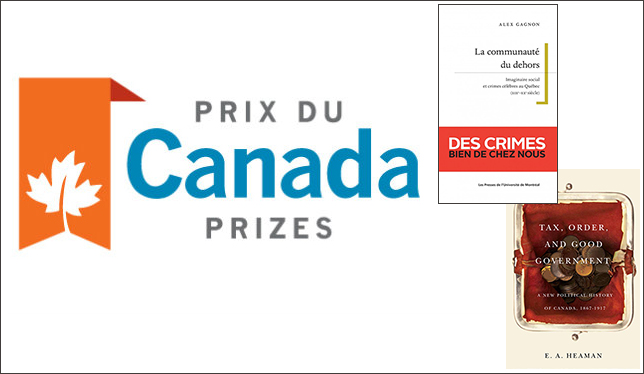
E.A. Heaman and Alex Gagnon have won the 2018 Canada Prizes in the Humanities and Social Sciences, for their books, Tax, Order, and Good Government: A New Political History of Canada, 1867-1917, and La communauté du dehors. Imaginaire social et crimes célèbres au Québec (XIXe-XXe siècle). The Canada Prizes are awarded each year by the Federation for the Humanities and Social Sciences in recognition of two scholarly books, one in English and one in French, that “make an exceptional contribution to scholarship, are engagingly written, and enrich the social, cultural and intellectual life of Canada.” Each of the 10 finalists received funding from the Awards to Scholarly Publications Program, or ASPP, administered by the Federation. The two winners will be honoured at a ceremony at the Congress for the Humanities and Social Sciences, held this year in Regina from May 26 to June 1. Read about the finalists in English below.
Click the arrow on the right to see the next nominee.
[masterslider id=”10″]



Featured Jobs
- Director, Human Research Ethics & Strategic AdvisorUniversity of Manitoba
- Psychology - Assistant Professor (Clinical Psychology)Western University
- Global Inequalities and Trade - Faculty PositionUniversité Laval
- KAUST Global Fellowship Program - Postdoctoral Fellowship (Call 2027)King Abdullah University of Science and Technology
- Theatre and Film - Assistant Professor Without Review (Performance Practice)The University of British Columbia
More from News
-

Parliamentary committee urges stronger support for research in French
Granting agencies should consider funding targets specifically for French-language projects, the Standing Committee on Science and Research recommends.
-

Remove EDI from research funding decisions, parliamentary committee says
The Standing Committee on Science and Research says ‘discriminatory’ EDI policies are ‘weakening the quality of Canadian research’.
-

Good medicine: new programs train country doctors
Université de Montreal follows Queen’s prescription to heal the shortage of family physicians in rural areas.
-

Quebec’s English-language universities embrace new French requirements as fall cohort begins
McGill, Concordia and Bishop’s universities roll out new initiatives to encourage students to learn French on and off campus.
More from Publishing
-

Open access: a diamond in the rough?
Science policy is increasingly talking about diamond open access. But what’s it all about?
-

How to save French-language science
The latest report from the Standing Committee on Science and Research concludes that a serious shake-up is needed to restore French-language science to its former glory in Canada.
-

Research re-imagined
As academics experiment with the graphic novel form, their research is reaching – and influencing – new audiences.
-
Catching up on open access
A decade ago, Canada was at the forefront of open access publishing. Now critics say those policies are due for a drastic rewrite.
More from Articles
-

Universities struggle to be heard in Quebec election
In a campaign dominated by the U.S. trade war and the soaring cost of living, universities assert their continued importance.
-
Attacks on higher education spread globally, including in liberal democracies, Scholars at Risk report finds
Canada urged to defend values amid erosion of institutional autonomy in the U.S.
-

Grad student visas double since 2025
Policy changes drive sharp rise in permits for international master’s and PhD candidates.
-

Where do Quebec’s political parties stand on higher education?
With the provincial election less than a month away, we provide a roundup of platforms and promises.


Post a comment
University Affairs moderates all comments according to the following guidelines. If approved, comments generally appear within one business day. We may republish particularly insightful remarks in our print edition or elsewhere.
1 Comments
Why does this article present only the English books that were nominated and not the French? It’s rather dissapointing. I feel like a good opportunity has been missed here.