World events put academics and journalists under pressure
At a time when news is always breaking and disinformation is on the rise, a conference explores the precarious relationship between academia and the media.
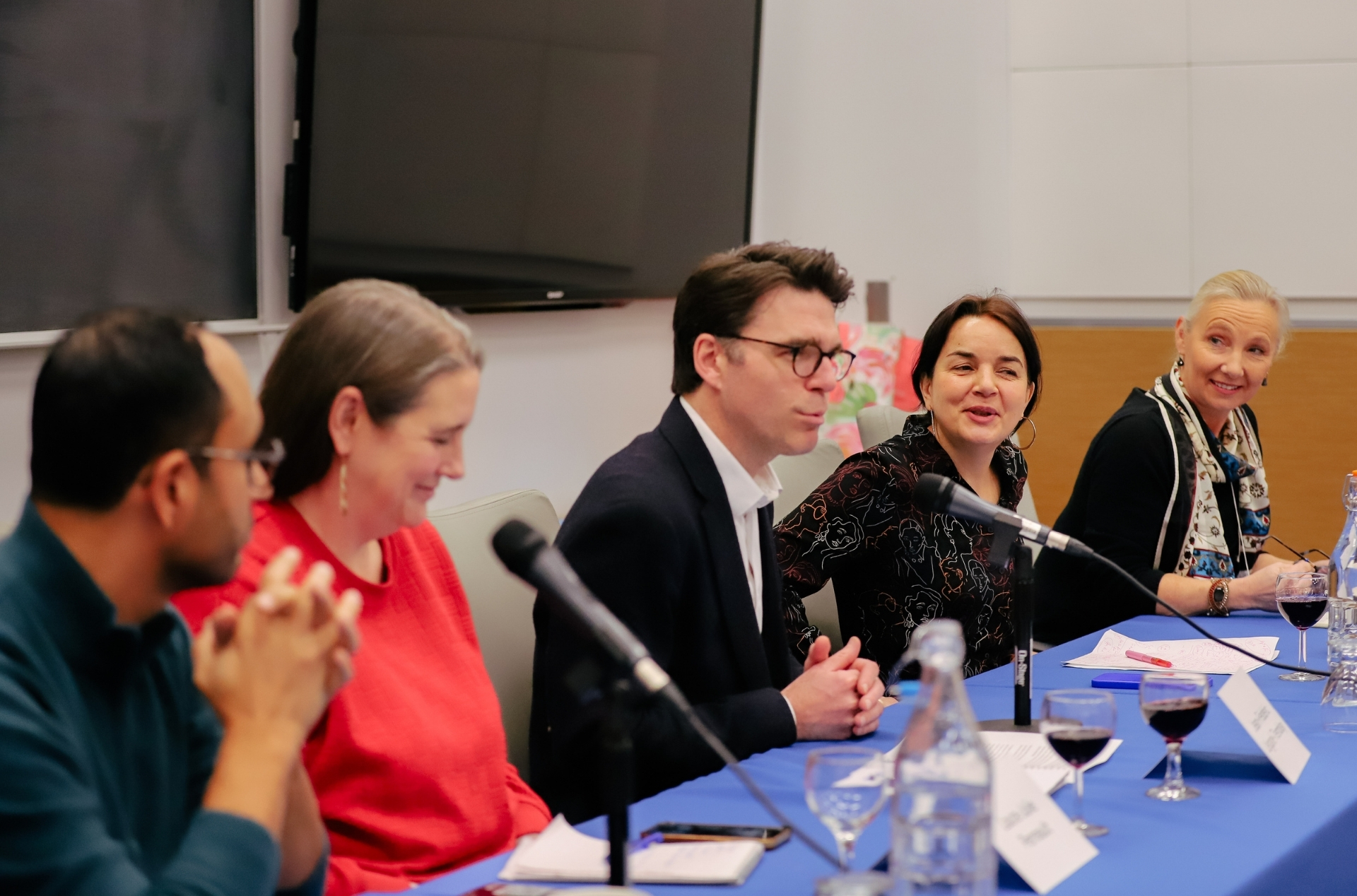
Here in Montreal in late January, global issues are no longer as remote as they once seemed. World events dominate the headlines, political debate, and even our day-to-day conversations. That’s what inspired the “Quand l’international fait la une” (When world events dominate the headlines) conference, hosted by the Centre d’études et de recherches internationales de l’Université de Montréal (Montreal Centre for International Studies—CÉRIUM) on January 29–30. Over the course of two days, journalists, researchers and students delved into the question of why the crucial relationship between the media and academia is increasingly strained.
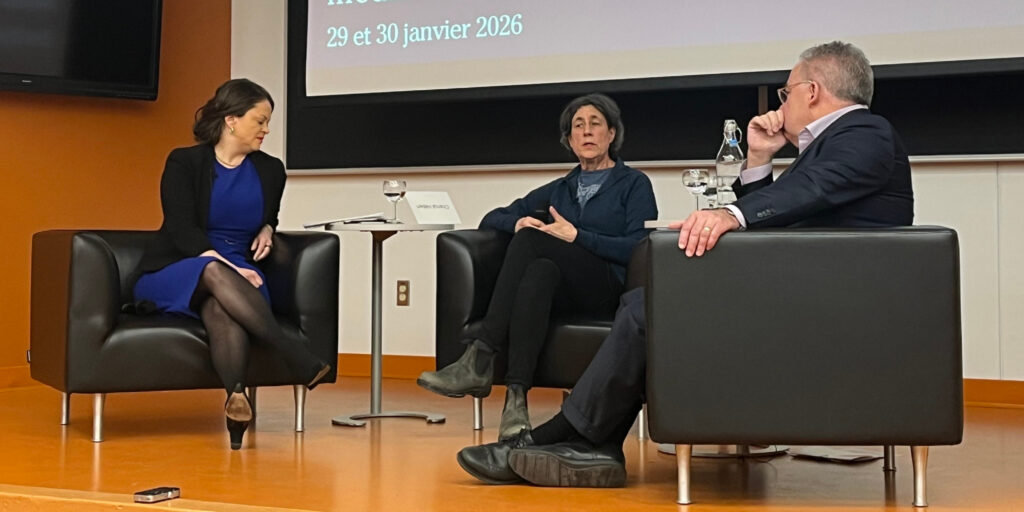
Journalists and commentators Paul Wells and Chantal Hébert opened the conference by summarizing the problem as they see it: world events are taking up so much space in the Canadian public conversation because of their increasing impact on domestic policy. Armed conflicts, Canada–US relations, and decisions made abroad all have immediate repercussions at home. Journalists have to tackle complex topics, often outside their area of expertise, while meeting ever-tighter deadlines.
Under these conditions, researchers become key resources. Calling an expert can facilitate fact-checking, add nuance to analysis, or prevent leaps of logic. But though this relationship is growing in importance, collaboration doesn’t necessarily come easily. Expectations are often unclear, and the two professions operate very differently.
These differences were laid bare when researchers and journalists faced off on the conference’s first afternoon. Across the table, each group got to take a good look at the other. On one side were the academics, who work with long timelines, caution and precision. On the other were journalists, accustomed to urgency, concision and distilling information for the general public.
For Magdalena Dembinska, professor of political science at the Université de Montréal (UdeM), the relationship between the two professions is complicated. Being asked for comment by the media brings recognition, but also stress. These requests often fall outside her specialty, especially when there are few other experts to call on in a given region. Accepting media requests puts you under the spotlight, while refusing sometimes means yielding the floor to less thorough analysis. Faced with this tough decision, Dr. Dembinska admits she sometimes lets media requests go to voicemail.
Cecile Van de Velde, full professor of sociology at UdeM, described media appearances as “risky but necessary.” There is always a real danger of having your research oversimplified, losing control over your statements, or being judged by peers. But speaking publicly allows your work to have an immediate impact and facilitates dialogue between academia and society, improving the reach of research usually only read by a few hundred people. She maintains it’s worth the risk.
Laura-Julie Perreault, a commentator on international affairs with La Presse, was blunt about the realities of journalism. Covering international news often requires becoming an expert in a country or conflict in a matter of hours, often far from a newsroom. That’s when an expert is essential. They can offer context, a bird’s-eye view, and an analytical depth that journalists don’t have time to construct on their own. Yet this relationship is delicate. Hours of interviews could translate to a single quote. Through no fault of either party, considerable work can be swept aside in an instant by breaking news.
Alexis De Lancer, journalist and moderator of Ça s’explique and Les Décrypteurs on Radio-Canada, offered another perspective, noting that long-form content changes the way journalists and academics interact. A framework can be built; nuance can be developed; there is more time to spend on complex points. Researchers and journalists both have more leeway. But long-form journalism remains an outlier in newsrooms, where opinion and commentary are given more and more space — often at the expense of analysis.
The problem of gender parity also continues to rear its head. The journalists at the conference noted how hard it remains to highlight women’s perspectives, especially on international issues. Women are more reluctant to speak and more likely to refuse comment. Several panellists noted that female researchers are much more hesitant to speak outside their specialty, struggle with fears of legitimacy, and worry about public exposure, which weakens public debate.
The second day of the conference took a broader view of the issues. Charlotte Bannerot, a master’s student in international studies at UdeM, presented research about how tensions between academics and the media are developing in an era of disinformation. Her conclusion is clear: as disinformation surges and public trust in institutions declines, academic reluctance to weigh in publicly is becoming problematic.
She explained the structural differences that can complicate collaboration between these professions. First, there’s timing: journalists move quickly, while research takes time. There is also the matter of language: academics must be precise, while journalists need to present ideas plainly. Then throw in professional constraints. Journalists work in precarious and often understaffed newsrooms, while the academic system values scientific publications above all else, leaving little room for media appearances.
Researchers often have no media training. They may feel imposter syndrome, worry about being discredited, and fear being attacked on social media. That goes double for academics who are part of a minority group or who are working on sensitive subjects. With this in mind, declining a request for media comment is never a neutral decision. When an academic declines, another person takes their place, and they may not bring the same rigour.
As the discussions progressed, it became clear that the relationship between academics and researchers cannot rely solely on individual goodwill. Ensuring that information and research can support democracy becomes a joint responsibility.


Featured Jobs
- Global Inequalities and Trade - Faculty PositionUniversité Laval
- International Studies - Faculty Position (Arctic Defence and Security)Université Laval
- Theatre and Film - Assistant Professor Without Review (Performance Practice)The University of British Columbia
- Movember Institute Discovery Research Program FellowshipsThe University of British Columbia
- Canada Impact+ Emerging Leader in Quantitative and AI-enabled Electron Microscopy for Quantum and Advanced MaterialsMcMaster University
More from News
-
NSERC announces Arthur B. McDonald Fellowship winners
Research council kicks off a week of prizes with grants for early-stage academics.
-
Feds announce $880 million for research
Funding will support both established health scientists and emerging cross-disciplinary researchers.
-
OCAD University celebrates 150 years of shaping Canadian culture
Art and design university launches $6-million campaign for 150 scholarships to mark 150th anniversary.
-

B.C. higher education: tweak or reform?
In the coming provincial election, parties offer different proposals for a system under strain.
More from Research
-

Canada ‘muddling through’ without national research infrastructure strategy, panel finds
Expert report says fragmented governance and funding threaten Canada's research competitiveness and scientific sovereignty.
-

The Nuisance Variable
Two-thirds of Alzheimer’s patients in Canada are women. Why does research still treat them as an afterthought?
-

How serendipity built a cross-disciplinary career
Taking research positions out of economic necessity allowed me to gather a broad set of skills and knowledge.
-

Science in French? Bien sûr!
As English dominates the publication landscape, support for French-language research is a strategic investment in the quality, equity and the future of knowledge.
More from Articles
-
Ottawa won’t restrict student visas from countries with high asylum-claim rates
India will help Canada ‘crack down’ on student program abuses, high commissioner says.
-

Students and seniors under the same roof
Intergenerational living helps with loneliness and the high cost of rent.
-
U Sports alum lace up for PWHL season
Canadian grads eager to show their mettle on women’s pro hockey teams.
-
The hidden problem of student homelessness
As high rents push more students into precarious housing, it's time to stop romanticizing the 'poor scholar'.


Post a comment
University Affairs moderates all comments according to the following guidelines. If approved, comments generally appear within one business day. We may republish particularly insightful remarks in our print edition or elsewhere.