Teaching in the great outdoors
A unique creative writing class at the University of Toronto connects students to nature.

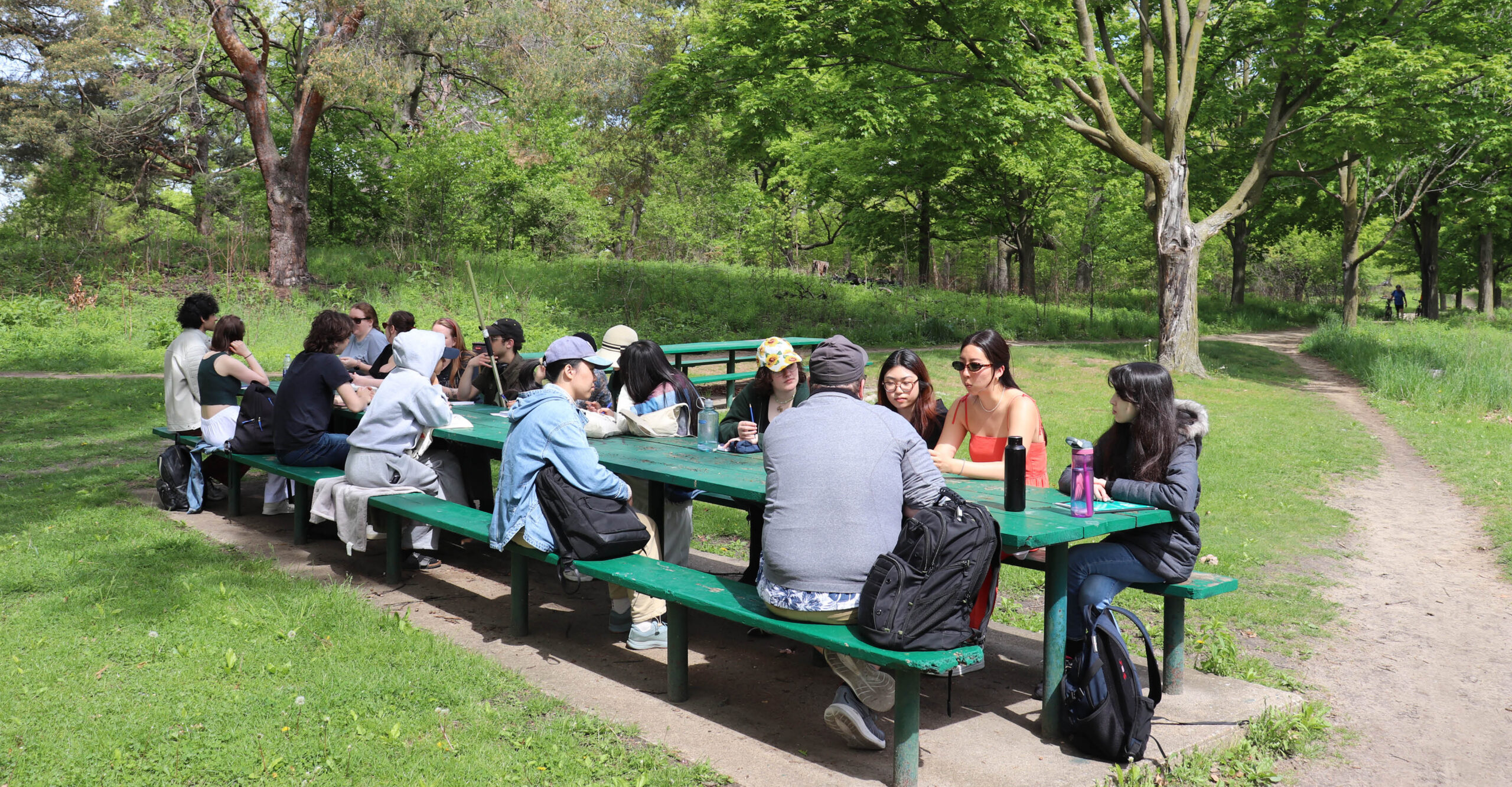
On a May morning in 2026, my students gather for class wearing hoodies and jackets. Several, like me, wear long winter coats. It’s 10° C, and the location I’ve chosen is shielded from the sun. But this nook of the university campus offers an appealing privacy and a weave of natural and built features: a cobblestone laneway lined with trees, outdoor seating, sparse traffic and relative quiet, rare in downtown Toronto. Tucked nearby between buildings is a hidden treasure: a small woodland of birches and maples, deliberately wilded, rich with the scent of leaves and forest mulch.
This is the second class of Creative Writing and Territory, an outdoor odyssey mapped onto a creative writing course that I designed and have taught since 2023. I’ve called this class “Meeting the Land.” We gather in a loose circle with hands stuffed in pockets. The essays assigned, by Kyo Maclear and Thomas King, prompt reflection on the stories we’re told, and tell ourselves, about who we are in relation to the living world, and what that world is actually like.
The writer Barry Lopez observed, “To include nature in our stories is to return to an older form of human awareness in which nature is not scenery, not a warehouse of natural resources, not real estate, not a possession, but a continuation of community.” Over the years, I’ve come to appreciate how urgently we need to regrow this “older form of awareness” that connects us to the community of the living world. Not simply as writers, scientists, managers, but as humans guided and sustained through life’s challenges by stories and relationships.
An intervention
Some dozen years ago, I used to assign a prompt to my undergraduate fiction students, asking them to write a scene set in the future. The future could be any time at all; my only stipulations were that the location was Earth, and that there had to be a thread of connection between the fictional future and something today. Anything at all. This instruction was meant to help them scry patterns of development and ground their imaginations a little.
Many students love speculative fiction, so I thought this would be a fun activity. After four or five iterations, however, I removed the prompt from class. The responses were almost entirely the same: 25 dystopian futures handed in each time, scenes of violence, oppression, delusion and misery. The planet was trashed. Society was a version of Mad Max, Big Brother or the Matrix.
We weren’t reading dystopian fiction together, but that didn’t matter. The students were reading the culture; they were shaped by its stories. That these young writers were sighting from relatively advantageous social positions themselves, globally speaking, didn’t brighten their conclusions about where humanity was headed.
Growing up in the 1970s and 80s, the dystopian classics I read also shaped me profoundly. They were largely cautionary novels like On the Beach, 1984, Brave New World, and A Canticle for Leibowitz, and they blasted me the same way reading about the death camps, slave ships and atom bombs in high school history classes had opened an existential void within. I contemplated suicide in high school; soothed my pain and tried to touch something transcendent with drugs. I could not understand this crazy world at all.
Half a century on, the warnings in these novels remain urgently alive. In light of today’s crises — political, social, ecological — future-imagining stories feel more important than ever. And yet, apocalyptic thinking has been normalized.
How might my classes speak to this despair, I wondered.
As a teacher, I felt I needed an intervention.
Enlargement
In Birds Art Life, Kyo Maclear writes about being unmoored by grief such that she sought to lose herself in something else — which turns out to be the living world, the birds who have been there all along. In my late 30s, I too was led through illness and grief to leave the human-centric mindset in which I’d lived my life. It felt like spiralling outward and softening my own borders at the same time, and took the shape of a month-long solo camping trip in northern Ontario. I’d never done such a thing. During those weeks I began to listen and sense differently, to walk in a forest like I might belong there. What and how I wrote changed. Writers like Lopez and Annie Dillard guided me forward, and eventually, I began to find others with the same yearnings and questions.
In 2018 I joined the research team of the Persephone Project, led by Professor Andrea Most, which sought to discover pedagogical and research approaches that are more earth-centric. Our three-year investigation showed me the far-reaching impacts on learning when walls and ceilings become wind and sky.
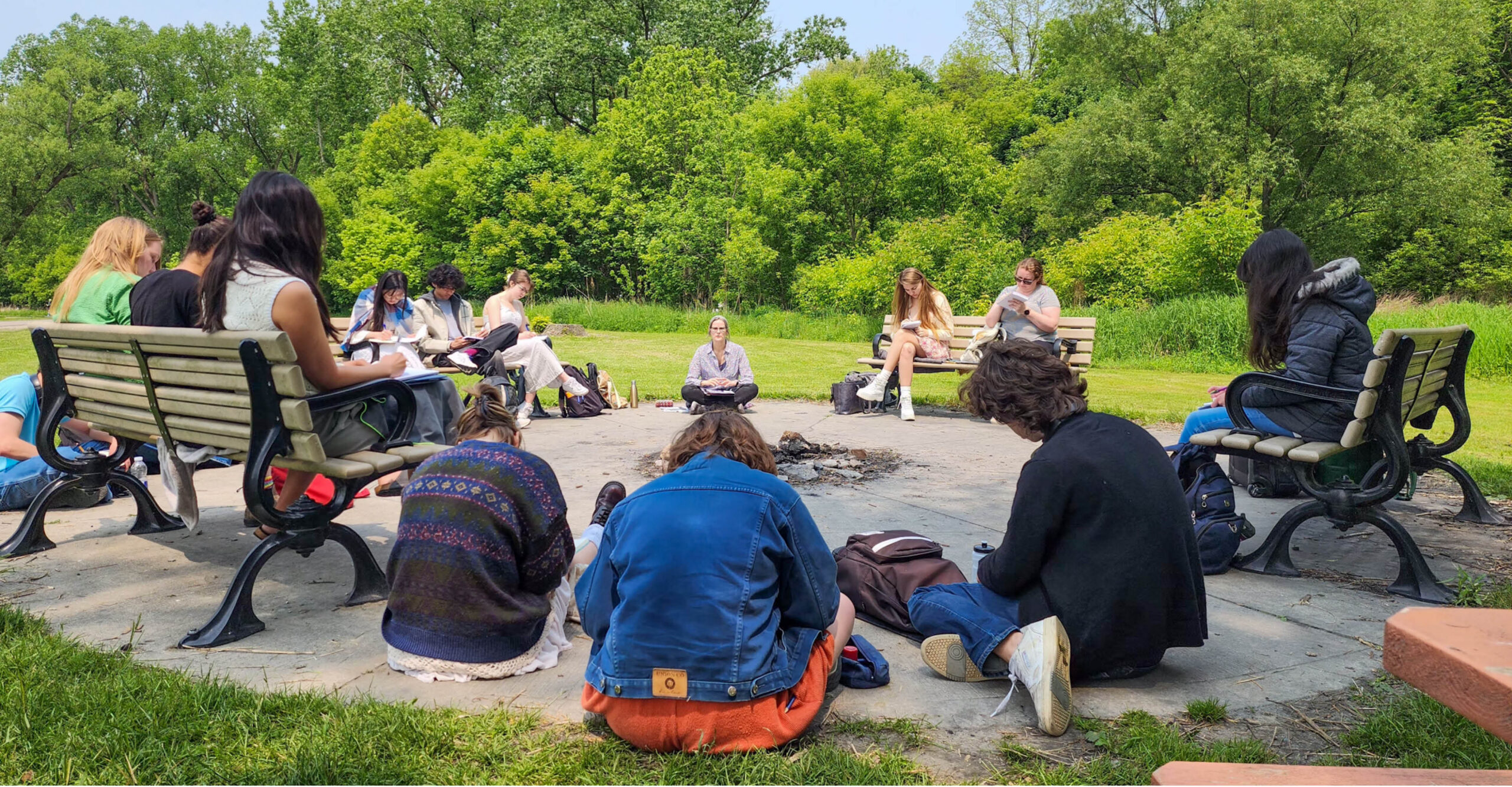
By our fourth class, the temperature sits around 12°C, with a hair-whipping wind. The course odyssey design means that we move location for each meeting, visiting places on campus and beyond. Today we meet at the fire circle in Christie Pits park, a popular neighbourhood destination several kilometers from campus on the subway line. Two years ago when I taught here, the sun was hot and the sky opaque with wildfire smoke. Today I’ve brought firewood. The four elements cycle through the course. Everyone experiences the elementals; they connect us to each other and to our home. They bring us back. While I’m not a great cook, I do have skill with fire, and it pleases me greatly to share this. Students huddle by the flames, their faces opened by the primal reassurance and connection a hearth fire offers. The creative prompts engage them in noticing the texture of the park: its different spaces, inhabitants, stories. They also write about their life experiences with fire in its myriad forms. They share fire stories.
Re-connection
We hear much about the importance of resilience today, and especially for university students. But where does resilience come from? How is it nourished? What are the examples?
A recent feature in The Times discusses the growing trend of working outdoors (cutely acronymized as WFG, work from garden). Citing the lead scientist of the Nature Connectedness Research Group at the University of Derby, the writer reviews the proven benefits of outdoor offices. The gains are wholistic: in physical and mental wellbeing, productivity, and also, notably, in an enhanced sense of meaningfulness to life.
This information isn’t new; educators have long been advocating outdoor classes for school-aged children. What seems new is the idea that we should all be outdoors, as much as possible. That many stresses can be lifted by this simple, costless shift from indoor segregation to world integration.
Yet moving outdoors is only the beginning. It’s developing an authentic connection to the living world — enlarging and softening, feeling part of that greater community, wherever we are — that nourishes us.
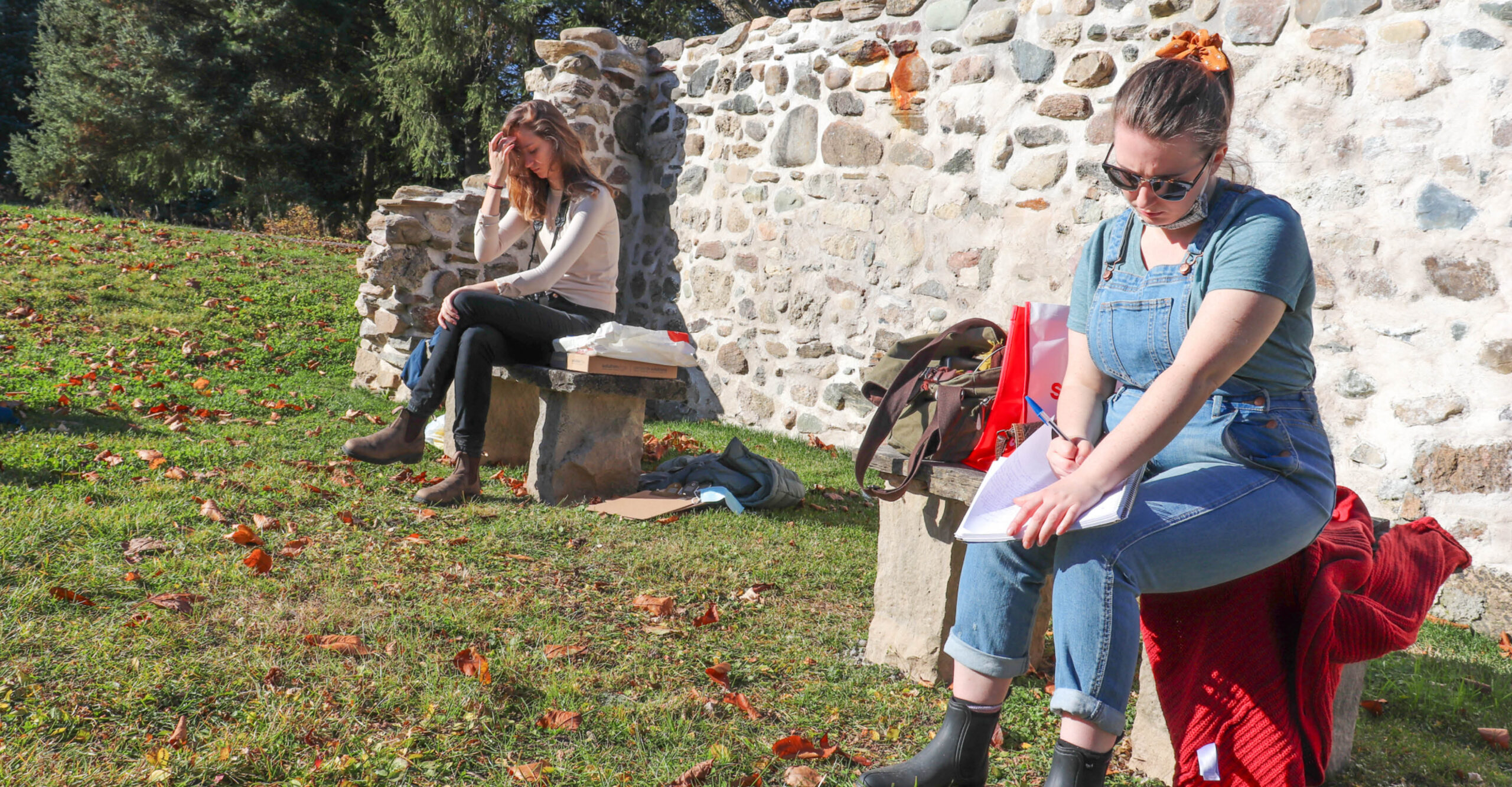
Students in Creative Writing and Territory have told me that, until they took the course, they rarely left campus. Never rode the subway, visited the culturally significant areas of the city, the parks, even the campus green spaces. International students arrive in the city rudderless. It stays a backdrop, a generic screen. I’ve chosen the travelling format so students gain confidence in navigation, sharpen attentiveness, and learn through experience that they can meet whatever unpredictable conditions and distractions a new situation and day offer. And they do. Students with both physical and emotional challenges thrive in class. Young people are hardier than we realize, given the right conditions.
Halfway through the course, we meet in High Park on a bright, warm day. We discuss why fantasy writers invent multiple worlds, what these bring to storytelling. One reason is to enlarge our perspective on this world and ourselves, helping us discern the limits of our knowledge, and that our values do not stand for all beings, at all times. Writing prompts focus on the multiple ‘worlds’ all around us, beyond human-centricity and this one temporal moment.
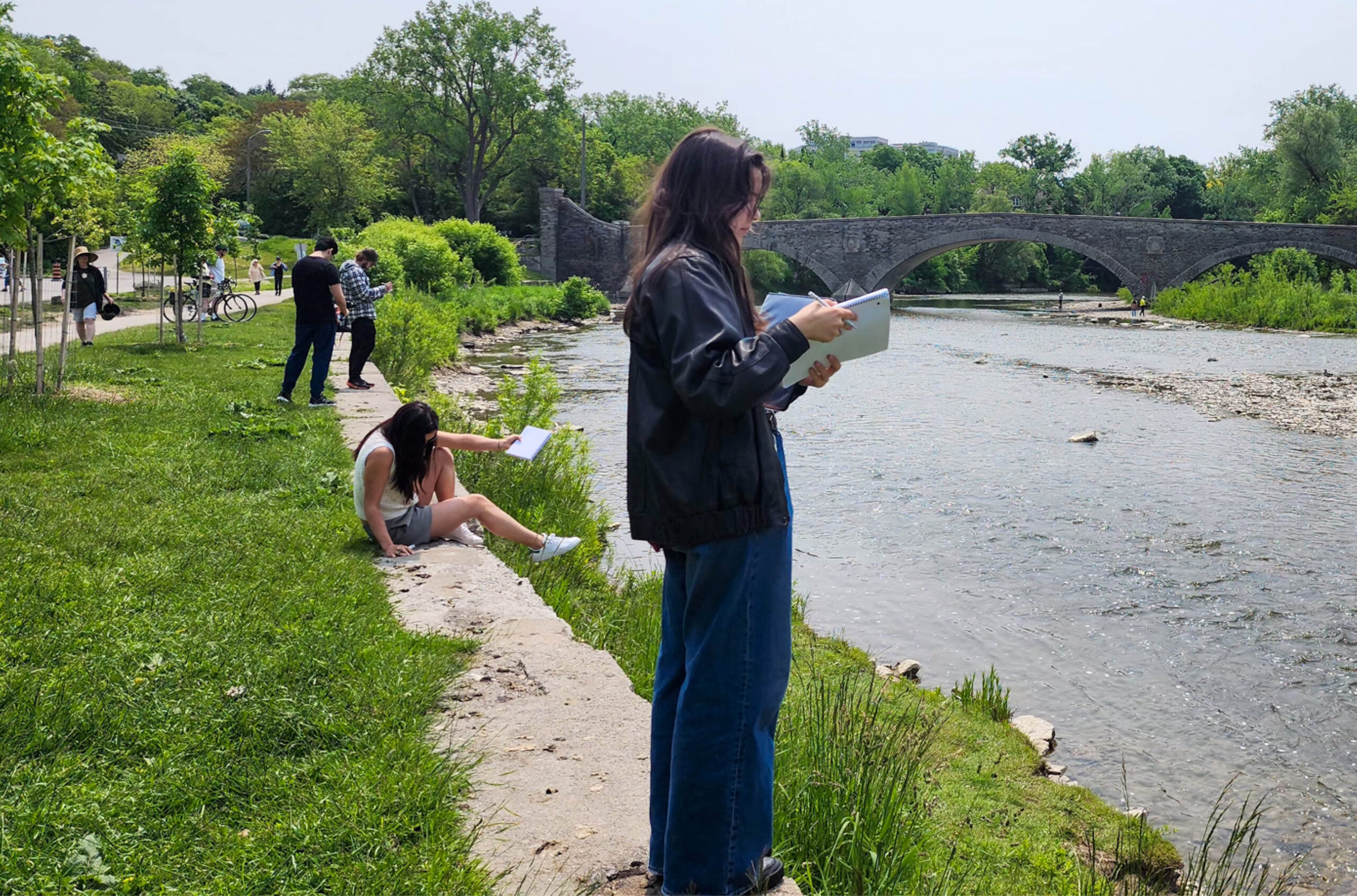
A week later we’re in the Humber River ravine, where cottonwood seeds drift like snow. The river shimmers. We read water stories, then students fan out along the riverbank in excited or dreamy postures, writing about experiences with water that will be crafted into fiction or essays.
Thomas King’s The Truth about Stories explores how personal story and world story are always entangled. University classes can make entanglement part of the teaching, embed lessons in the weather, model and nourish resilience. Outdoor time can be designed into any course, including assignments; responding to challenges and mishaps, like noise and rain, is part of the learning.
The many crises we face today could be said, fundamentally, to be only one: a crisis of disconnection. Bringing learning into the natural world enlivens students. It invites them to see how a meaningful relationship with the whole living community has always existed for them, and always will. It invites them to attend to this relationship with spirit, as they tend their own well-being. We should meet our students, and ourselves, in the living world.



Featured Jobs
- Toldo Chair in Christian StudiesAssumption University
- Theatre and Film - Assistant Professor Without Review (Performance Practice)The University of British Columbia
- International Studies - Faculty Position (Arctic Defence and Security)Université Laval
- Psychology - Assistant Professor (Clinical Psychology)Western University
- Movember Institute Discovery Research Program FellowshipsThe University of British Columbia
More from Career Advice
-

How serendipity built a cross-disciplinary career
Taking research positions out of economic necessity allowed me to gather a broad set of skills and knowledge.
-

From doctoral student to entrepreneur
Resources abound to help you turn your PhD research into a business startup.
-
Internationalizing Truth And Reconciliation through multilingual storytelling
Faculty share stories in their home and heart languages in the University of the Fraser Valley’s Leq'áleq’el Video Series.
-

Show it clearly: illustrating a report for your community partners
Part II: How to design figures that tell your story.
More from Mental Health
-

Life lessons from the World Happiness Report
Happiness is a gift for elders to pass on to the younger generation.
-
When misconduct moves on
Universities need a fair way to share serious misconduct findings across institutions.
-

When misconduct disappears into university bureaucracy
Universities have procedures for misconduct, but too often lack the governance structures needed to see the patterns that emerge across sectors.
-

When collegiality breeds contempt
As academics compete for scarce resources, collective decision-making can lead to abuse — but that’s no reason to dismantle the system.
More from Career Advice Articles
-

Can you spot an essay written by AI?
Learn the common patterns, limitations, and clues that may reveal AI-generated writing.
-

The secret to good labour relations
Two negotiators — one from a faculty association, one from a university administration — share their advice for building trust and achieving the common good.
-

Why are multiple-choice questions making a comeback?
Distinguishing the correct answer from plausible, but incorrect, alternatives sharpens students' skills in detecting AI slop.
-

Help! AI stole my students’ brains!
Why professors must teach undergrads to think critically about artificial intelligence tools.


Post a comment
University Affairs moderates all comments according to the following guidelines. If approved, comments generally appear within one business day. We may republish particularly insightful remarks in our print edition or elsewhere.