A look inside the hive: celebrating honey bee research at two Canadian universities
As MacEwan University marks 10 years of bees on campus, the University of Guelph kicked off the year by unveiling its newest centre for honey bee research.
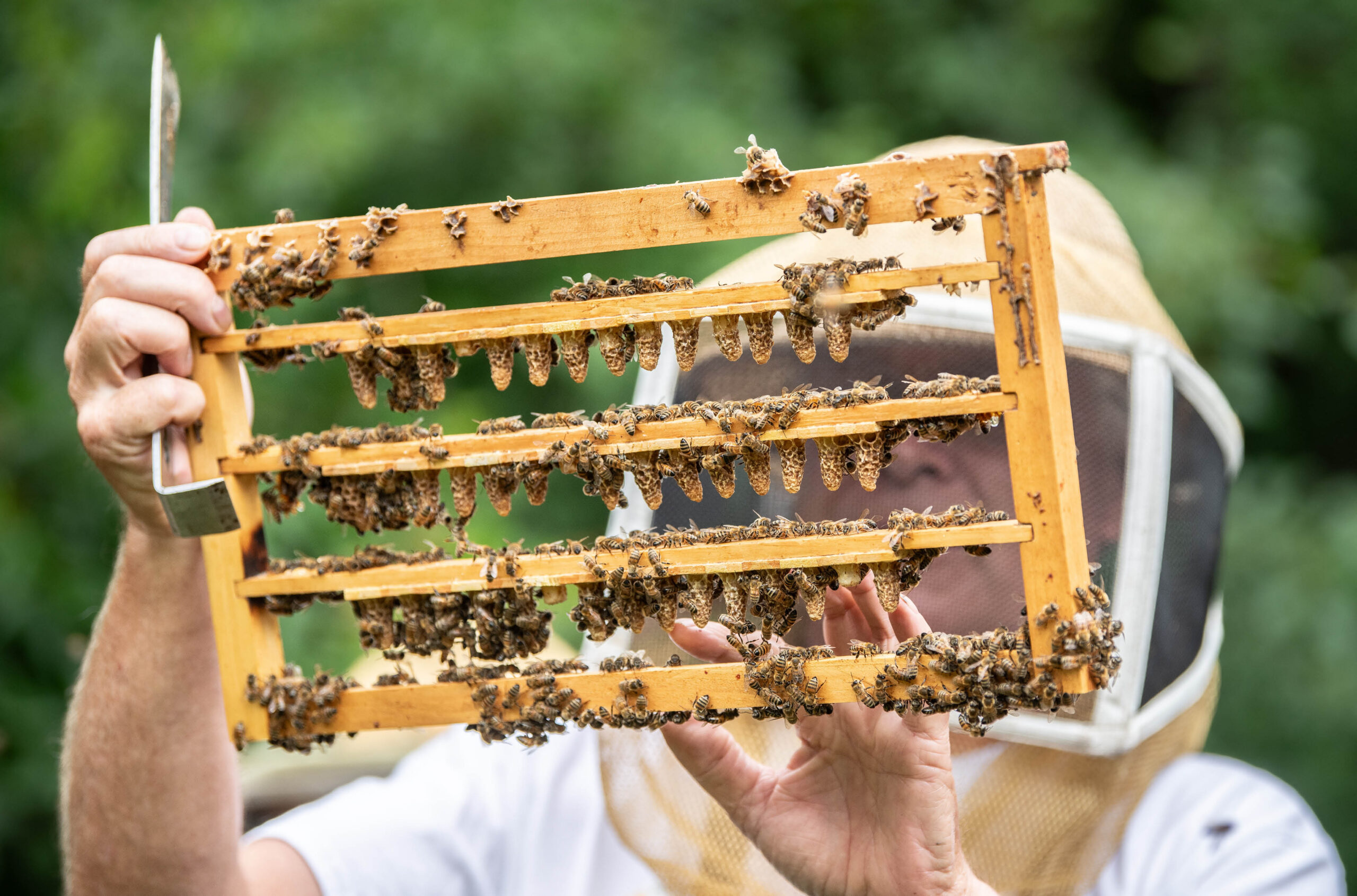
Small, fuzzy and integral to the sustainability of our ecosystems — honey bees are responsible for nearly one-third of the produce found across Canadian grocery stores.
“Bees are very important for human food production; its everything from fruits to nuts, to seeds, to berries, and to some vegetables…so it’s basically where we get the bulk of our nutrition,” stated Paul Kelly, research and apiary manager at the Honey Bee Research Centre (HRBC) from the University of Guelph.
There, researchers dedicate their work to helping honey bees fulfil their role as key pollinators. Without their foraging — which involves the cross-pollination of flowering plants and fruit blossoms — most of the pollination from flowering plants would not take place; thus, resulting in an overall decline of necessary human-reliant crops.
With a long history of apiculture research and education, the University of Guelph has become widely renowned for its beekeeping practices. Mr. Kelly — who has spent 40 years as manager of the honey bee research centre at the University of Guelph — says his career in the beekeeping industry has been truly rewarding. “The highlight of my career is the people that I’ve had the privilege of working with… So many young students and interns getting their first exposure to bees, volunteering with us to learn more, becoming employees, and then establishing careers as beekeepers, bee researchers or using the skills learned here at the HBRC in other fields.”
Bee Fact
While worker bees—the females—only live up to 40 days, a colony of honey bees in early spring can house up to 15,000 bees and reach between 50,000 and 80,000 by the peak of the summer. At MacEwan University, where they manage eight hives, Troy Donovan, Head Beekeeper, remarked “when all the hives are full and they’re just producing honey and going full speed, then it could be closer to a million bees.”
University of Guelph Luckevich Pinchin Honey Bee Research Centre:
At the University of Guelph, the newly opened Luckevich Pinchin Honey Bee Research Centre (HBRC) builds on more than 130 years of apiculture research and training dating back to 1894. Home to a molecular biology laboratory, 300 beehives, and an indoor overwintering room, researchers at the centre dedicate their work to understanding honeybee health and developing products that help combat their greatest threat: the Varroa destructor mite.
Much of the research has been driven by increasing colony losses over the past two decades. Mr. Kelly recounts how, “back in 2007, we started experiencing much higher losses in Ontario; since then, our losses have averaged about 35% of our colonies per year in the province, and some years have been higher than that.”
With an increase in abnormal weather patterns, the problem has only been exacerbated. [As for climate change] “It’s not warm temperatures that are much of a problem for us, but it’s wonky weather—like when it’s really dry and the plants dry up…there’s no nutrition for bees. And, if we have a really early spring, that can be great for our bees, but it also means it’s great for the parasite that thrives on them,” explained Mr. Kelly.
To tackle the parasite, researchers at the centre have been busy investigating a variety of naturally occurring treatments. “Right now, we’re working on essential plant oils and their effect against parasitic mites—and that’s been going on for about fifteen years,” remarked Mr. Kelly. “We’re using the oils from the plant thyme, oregano, [and] (to some extent) clove, but we’re also using organic acids, formic acid, and oxyacid.” Their primary goal is to find natural materials that can kill the mite but pose no threat to the bee.
Did You Know?
Honey Bee beekeeping has existed in North America since it was first introduced by early settlers to tackle the limited and expensive supply of sugar. Today, the many advances in honey bee agriculture have allowed the practice to grow exponentially across Canada.
MacEwan University Urban Beekeeping Project
For 10 years, MacEwan University has hosted honey bees as part of their Urban Beekeeping project. Led by head beekeeper Troy Donovan, the inspiration of the project came about with the introduction of new technologies—the flow hive in particular—and the “exciting idea that you could just leave the bees in place and harvest honey right out of the back of the hive and then wrap, put it back together, and they would just keep producing honey.”
The initiative began modestly. As Mr. Donovan recalls, “we kicked off the process very small—just four hives at the start—and then when the first honey harvest came, of course everyone was like “I want some, I want some”.”
The honey was an instant hit and “for the first three, four, five years, it sold out within seconds!” With the help of collaborators, they were able to sell a variety of things, from lip balms, to candles, and even honey beer. Beer, he says “has been the most consistent for the last couple of years.”
With a growing demand for honey, the project started to expand with the help of students and faculty volunteers. “[We’re] typically a team of three or four [but] we’ve expanded it to a team of six now with some good tools around organization,” says Mr. Donovan.
Today, it has developed from four to eight hives; last year alone, the university harvested a record of over 70 kilograms of honey.
For Mr. Donovan, however, the work extends well beyond harvesting. “My job is to keep the bees alive all summer, stop them from swarming, and then put them safely into winter—because they stay [in their hives] on the roof all winter long.”
While beekeeping is not offered as a course at MacEwan, the project has increasingly attracted the attention of students and faculties for research and development purposes. As some scholars analyze the scientific properties of honey, others use the project as an opportunity to educate younger generations of children about what it means to care for our environment.
Beekeeping in Canada
Although the majority of honey bee colonies are kept in the prairie provinces, the highest proportion of beekeepers operate in Ontario and British Columbia—“managing 24% of the national total of colonies” (2025). In Alberta—home MacEwan University—the total number of beekeepers in 2025 was 1,630; in Ontario—where the University of Guelph can be found—the final count totaled 5,195.
Inside the Hive
Not every bee in a hive has the same role. In a single colony, the bees with the most responsibility are the female worker bees; they collect food and water, build combs, raise larvae, protect the hive, and care for the queen. Male honey bees, on the other hand, serve one purpose: to mate with queen’s from outside their colony. During breeding season, drones can travel up to five kilometres to areas known as “drone congregation sites,” where they come together in search of a new queen.



Featured Jobs
- Theatre and Film - Assistant Professor Without Review (Performance Practice)The University of British Columbia
- Global Inequalities and Trade - Faculty PositionUniversité Laval
- Movember Institute Discovery Research Program FellowshipsThe University of British Columbia
- Director, Human Research Ethics & Strategic AdvisorUniversity of Manitoba
- Psychology - Assistant Professor (Clinical Psychology)Western University
More from News
-

Ottawa won’t restrict student visas from countries with high asylum-claim rates
India will help Canada ‘crack down’ on student program abuses, high commissioner says.
-

Students and seniors under the same roof
Intergenerational living helps with loneliness and the high cost of rent.
-

U Sports alum lace up for PWHL season
Canadian grads eager to show their mettle on women’s pro hockey teams.
-

The hidden problem of student homelessness
As high rents push more students into precarious housing, it's time to stop romanticizing the 'poor scholar'.
More from Research
-

How serendipity built a cross-disciplinary career
Taking research positions out of economic necessity allowed me to gather a broad set of skills and knowledge.
-

Science in French? Bien sûr!
As English dominates the publication landscape, support for French-language research is a strategic investment in the quality, equity and the future of knowledge.
-

From doctoral student to entrepreneur
Resources abound to help you turn your PhD research into a business startup.
-
Ottawa announces 64 new research chairs in international talent attraction strategy
Top-tier researchers from 13 countries to join Canadian universities in first wave of appointments.
More from Articles
-

Parliamentary committee urges stronger support for research in French
Granting agencies should consider funding targets specifically for French-language projects, the Standing Committee on Science and Research recommends.
-

Remove EDI from research funding decisions, parliamentary committee says
The Standing Committee on Science and Research says ‘discriminatory’ EDI policies are ‘weakening the quality of Canadian research’.
-

Good medicine: new programs train country doctors
Université de Montreal follows Queen’s prescription to heal the shortage of family physicians in rural areas.
-

Universities struggle to be heard in Quebec election
In a campaign dominated by the U.S. trade war and the soaring cost of living, universities assert their continued importance.

Post a comment
University Affairs moderates all comments according to the following guidelines. If approved, comments generally appear within one business day. We may republish particularly insightful remarks in our print edition or elsewhere.